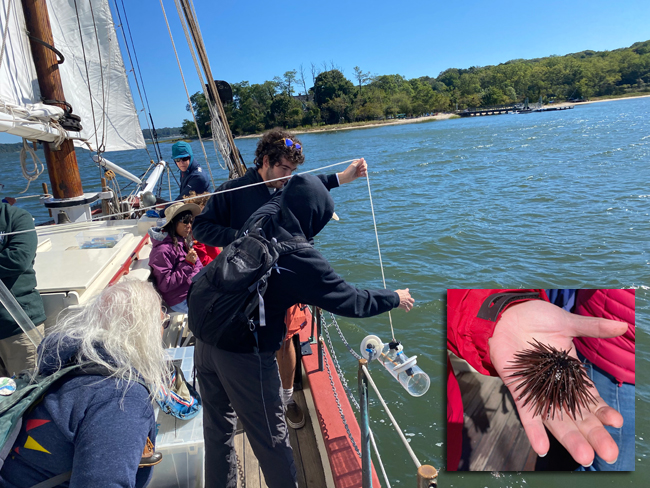
Educators at a Mentor Teacher Workshop held in Oyster Bay on September 20th demoed some educational tools aboard The Waterfront Center’s vessel Christine, exploring water quality parameters, sediment, and biodiversity. Credits: Jimena Perez-Viscasillas/NYSG; (insert) Fanny Kleisler
— By Sumayyah Uddin, NYSG's Science Writer
Contacts:
Jimena Perez-Viscasillas, NYSG Long Island Sound Partnership Outreach Coordinator, E: jbp25@cornell.edu, P: (631) 824-4906
Lillit (Lilli) Genovesi, NYSG Long Island Sound Partnership Outreach Coordinator, NYC, E: Lillit.Genovesi@cornell.edu, P: (718) 874-0120
New York, NY, December 7, 2025 - New York City-adjacent educators had the opportunity to attend three different teacher workshops in late September courtesy of the Long Island Sound Partnership (LISP), a cooperative organization of the U.S. Environmental Protection Agency, New York Sea Grant (NYSG), Connecticut Sea Grant and multiple federal and state agencies and nonprofits: workshops on water quality, on watershed and coastal science, and on using groundwater resources as learning tools in the classroom. Participants were given the opportunity to earn CTLE credits upon request.
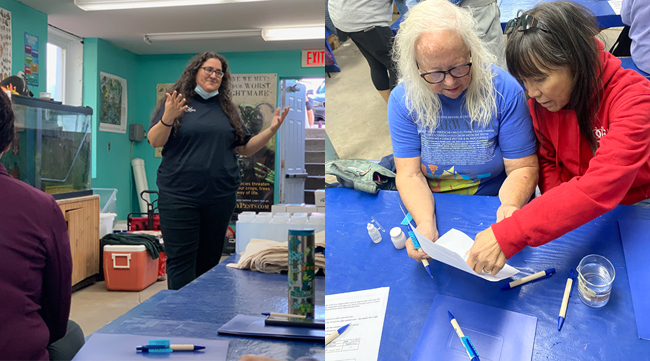
(at left) Jimena Perez-Viscasillas, one of NYSG's Long Island Sound Partnership outreach coordinators, highlights some of the Long Island Sound-related resources being made available to educators (such as those at right) at a mentor training workshop held in Oyster Bay on September 20th. Credits: (left) Fanny Kleisler; (right) Jimena Perez-Viscasillas/NYSG
The workshops (held September 20th and 24th) were intended to engage educators in Long Island Sound-related lessons, activities, and resources, and were administered by NYSG’s two LISP outreach coordinators: Lilli Genovesi (based in Queens) and Jimena Perez-Viscasillas (based at Stony Brook University on Long Island). The workshops are part of LISP’s Long Island Sound Mentor Teacher Program, through which teams of teachers are provided financial and technical support to develop and host their own workshops for other educators.
“The people who are most familiar with what teachers need are the teachers themselves,” Perez-Viscasillas said of the intentions behind the workshops. “It’s great to be able to facilitate a way for them to share with their peers the lessons they themselves have found effective when teaching about Long Island Sound.”
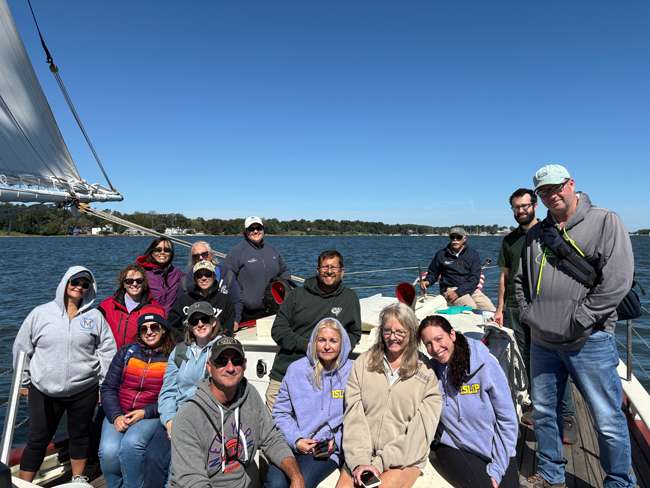
Attendees at the September 20th Mentor Teacher Workshop held in Oyster Bay. Credit: Jimena Perez-Viscasillas/NYSG
Water Quality, Coastal Science, and Hands-On Education
The two concurrent sessions took place on Saturday, September 20th in Oyster Bay and the Bronx.
The Long Island Sound Solution: From Waste to Wonder workshop (held in Oyster Bay, NY), led by NYS Master Teachers Mike Polochak and Christine Sanfratello and coordinated by Perez-Viscasillas, introduced participants to different water quality monitoring methods. K-12 educators who attended had the chance to hear from guest speaker Ryan O’Mara of the NYS Department of Environmental Conservation (NYSDEC) on NYSDEC’s water quality monitoring programs, took home resources for administering STEM activities with their students, and participated in water quality monitoring from the deck of the vessel Christeen with The Waterfront Center.
Post-workshop evaluations were positive and the majority of the attendees indicated that they would be using what they learned in their classrooms.
“[This was] one of the best professional development opportunity lessons I’ve participated in,” one educator shared about the workshop, while another participant emphasized that “the boat ride was phenomenal and the testing was useful.”
The From Stream to Sound: Watershed Science for the Classroom workshop (held in the Bronx, NY), brought educators to Soundview Park for a day of activities centered around exploring local water quality.
"Long Island Sound can quickly become a dynamic classroom for educators looking to bring place-based learning and real-life local examples into their teaching,” Genovesi said about the NYC based workshop. “At this year’s event, two Earth Science teachers from the Bronx led a workshop designed to help fellow educators explore New York City's rain gardens, combined sewer overflow (CSO) outfalls, green infrastructure, and stream physics in action.”
The two workshop coordinators, both experienced mentor teachers from World View High School, guided registered participants through local ecology and water quality activities, led them on a green infrastructure playground tour, and provided information about stewardship activities with the environmental nonprofit The Bronx is Blooming.
The workshop received extremely positive feedback, with participants specifically asking for more ideas on how to use LISP-provided data and mapping tools. The teachers who participated not only enjoyed the online resources, tools, and networking opportunities; they also felt that they benefited from the intimate group and setting, stating that it was a great chance to connect with fellow educators.
“This was such a fun, informative, and engaging [professional development experience] with lots of useful resources,” said one educator. Another highlighted the importance of bilingual educational materials, which were focused on during the workshop: “I interact with many Spanish speakers, and so many people really appreciate that the Living Treasures booklets come in Spanish.”
The NYSSLs Lessons for Science Educators K-12 workshop (held in Kings Park, NY), led by teachers and geologists Torie Hehir and Bob Mozer, coordinated by Perez-Viscasillas, and held on the 24th, focused on inviting K-12 teachers to a day centered around lessons based on NYS State Science Learning Standards. Participants had the opportunity to demo lessons, tools, and activities that they could bring back into the classroom to teach their students about watershed connectivity and water as a limited resource.
Participants found the workshop helpful, with one saying that “getting to meet new people, talk about watersheds and how they worked” was especially useful, while another appreciated the chance to engage in “hands on experiments and learning.”
Conclusion
Each workshop helped introduce educators to different ways of incorporating lessons about water quality, local ecosystems, and coastal communities in their classrooms.
“By examining the rivers that flow into the Sound, teachers can help students understand how upstream actions impact coastal ecosystems, water quality, and the surrounding communities — transforming abstract classroom lessons into tangible, community-connected learning experiences,” said Genovesi.
The experience left many participants feeling inspired — and ready to bring their own curiosity and perspective as learners back to their students.
“I loved this workshop! Really great refresher on watershed science and so fun to do hands-on activities,” shared one educator. “Forever a student!”
More Info: New York Sea Grant
Established in 1966, the National Oceanic and Atmospheric Administration (NOAA)’s National Sea Grant College Program promotes the informed stewardship of coastal resources in 34 joint federal/state university-based programs in every U.S. coastal state (marine and Great Lakes) and Puerto Rico. The Sea Grant model has also inspired similar projects in the Pacific region, Korea and Indonesia.
Since 1971, New York Sea Grant (NYSG) has represented a statewide network of integrated research, education and extension services promoting coastal community economic vitality, environmental sustainability and citizen awareness and understanding about the State’s marine and Great Lakes resources.
NYSG historically leverages on average a 3 to 6-fold return on each invested federal dollar, annually. We benefit from this, as these resources are invested in Sea Grant staff and their work in communities right here in New York.
Through NYSG’s efforts, the combined talents of university scientists and extension specialists help develop and transfer science-based information to many coastal user groups—businesses and industries, federal, state and local government decision-makers and agency managers, educators, the media and the interested public.
New York Sea Grant, one of the largest of the state Sea Grant programs, is a cooperative program of the State University of New York (SUNY) and Cornell University. The program maintains Great Lakes offices at Cornell University, SUNY Buffalo, Rochester Institute of Technology, SUNY Oswego, the Wayne County Cooperative Extension office in Newark, and in Watertown. In the State's marine waters, NYSG has offices at Stony Brook University and with Cornell Cooperative Extension of Nassau County on Long Island, in Queens, at Brooklyn College, with Cornell Cooperative Extension in NYC, in Bronx, with Cornell Cooperative Extension of Ulster County in Kingston, and with Cornell Cooperative Extension of Westchester County in Elmsford.
For updates on Sea Grant activities: www.nyseagrant.org, follow us on social media (Facebook, Twitter/X, Instagram, Bluesky, LinkedIn, and YouTube). NYSG offers a free e-list sign up via www.nyseagrant.org/nycoastlines for its flagship publication, NY Coastlines/Currents, which it publishes 2-3 times a year.