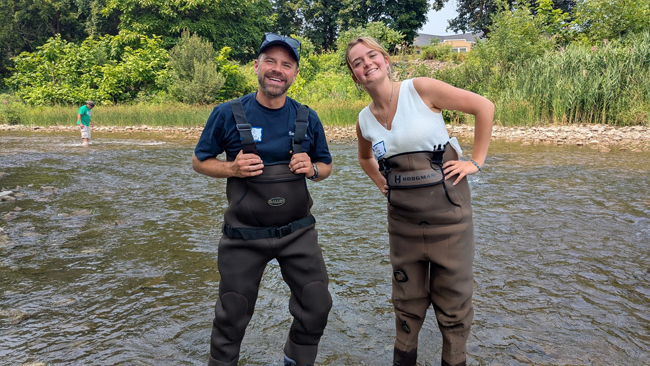
At GLEEE Workshop on August 4th, NYSG Great Lakes Literary Specialist Nate Drag (at left, pictured with Summer 2025 Community Engaged Intern Isabel Hahl) led participants in a streamside mussel survey, which is used to help determine how many mussels are present in our waterways. Credit: Nate Drag/NYSG
— By Sumayyah Uddin, NYSG's Science Writer
Contact:
Nate Drag, NYSG Great Lakes Literacy Specialist, E: nwd4@cornell.edu, P: (716) 270-2408
Buffalo, NY, December 7, 2025 - This past summer, New York Sea Grant (NYSG) and partners — including the New York State Department of Conservation (NYSDEC) and researchers from SUNY Oswego, University at Buffalo and Cornell University — held three different educator workshops for teachers eager to learn over summer break: the Great Lakes Ecosystem Education Exchange (GLEEE) Workshops, the CASCADE Curriculum Workshop, and the Mollusca Curriculum Development Workshop.
Attended by teachers and educators from all over New York State, the workshops are professional development opportunities that not only introduce challenges facing local ecosystems and communities, but also highlight the researchers working on solutions to these problems and curriculum resources that the teachers can use to bring these ideas to their students. Some of the topics included keeping plastic pollution out of the Great Lakes; understanding how changing environmental conditions impacts native fish and mussel species; and using technology to remove microplastics from surface water.

Participants at NYSG's Summer 2025 GLEEE Workshops, in Buffalo on July 22nd (on top) and in Oswego in August 4th (on bottom). Credit: Nate Drag/NYSG
Great Lakes Species in Changing Environments – GLEEE Workshops
The Great Lakes Ecosystem Education Exchange (GLEEE), a collaborative program between NYSG and the NYSDEC that is funded by the NYS Environmental Protection Fund, aims to develop experiential environmental education programming that builds awareness, appreciation and stewardship of NY’s Great Lakes. This year, forty educators participated in the two workshops (held in Oswego and in Buffalo), which focused on Great Lakes native species like cisco, lake trout, and various freshwater mussels in changing environments. They were both facilitated by NYSG Great Lakes Literary Specialist Nate Drag.
“The goal of the [GLEEE] workshops is to empower educators with knowledge about our local watersheds and the species that live in them, so they are confident working with students in K-12 classrooms and programs on these topics,” Drag said. “Our hope is that the lessons and activities that come out of these workshops will help students become stewards of the watersheds where they live.”
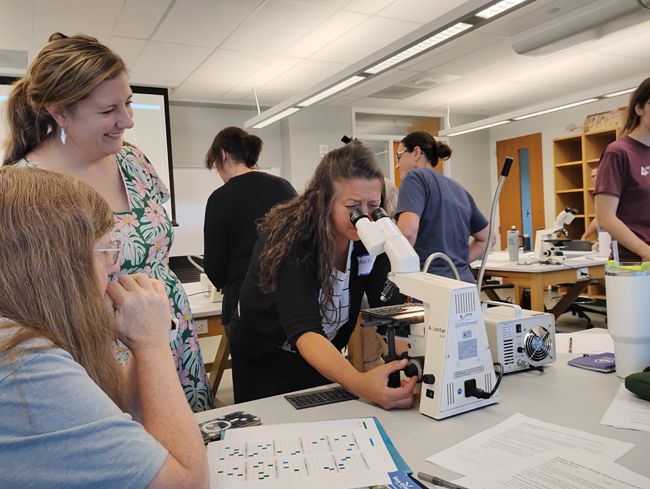
In the July 22nd native fish summer 2025 workshop, held at SUNY Oswego, attendees explored how changing environments impact fish like cisco and lake trout. Pictured at far left is Stacy Furgal, NYSG's Great Lakes Fisheries and Ecosystem Specialist, who looks on as participants get hands-on in the lab with otolith aging techniques. Credit: Nate Drag/NYSG
At the Oswego workshop, participants learned about the history of the Lake Ontario fishery and the role unique Great Lakes species like cisco and lake trout play in local ecosystems from NYSG Great Lakes Fisheries and Ecosystem Health Specialist Stacy Furgal. Furgal also led a hands-on demonstration to show educators how to age fish using otolith (a structure in a fish’s inner ear that helps with hearing and balance). In the second part of the workshop, educators worked with Dr. Nicholas Sard from SUNY Oswego to develop a lesson plan demonstrating how the varying amount of ice coverage in the winter can affect lake perch populations, as well as having the opportunity to tour Dr. Sard’s lab on campus.
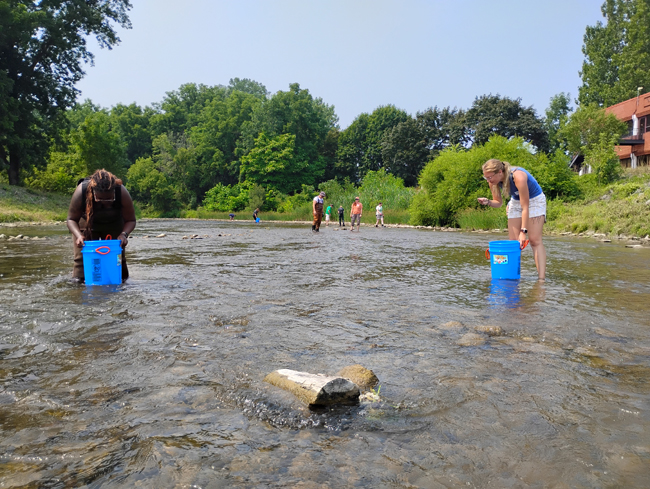
In the August 4th freshwater mussels workshop, held at the University at Buffalo, educators joined researchers for a streamside mussel survey and learned how these vital species are affected by environmental change. Credit: Nate Drag/NYSG
Participants in the Buffalo workshop focused on a different Great Lakes species: freshwater mussels. Educators learned about the unique life cycle and wide variety of freshwater mussels in New York’s Great Lakes region, then used that knowledge during participatory learning activities focused on mussel shell identification and the mussel-fish host relationship. They also had the opportunity to meet with Dr. Isabel Porto-Hannes and Dr. Corey Krabbenhoft from the University of Buffalo to learn about their ongoing research to survey and support freshwater mussels populations in Western New York waterways — including doing a streamside mussel survey (helping determine how many mussels were present in certain waterways).
The workshops helped educators prepare for lesson plans on protecting and nurturing native species.
“It was awesome that we were able to actually go to Ellicott Creek for some real hands-on activities,” one of the educators said. “I rarely see training in which we truly put what we learned to practice, so this training was very refreshing.”
Another participant mused on the possible applications of what they learned from the workshop: “I am going to incorporate this content into my water cycle unit so my students have a bigger and more concrete understanding of our local waterways.”
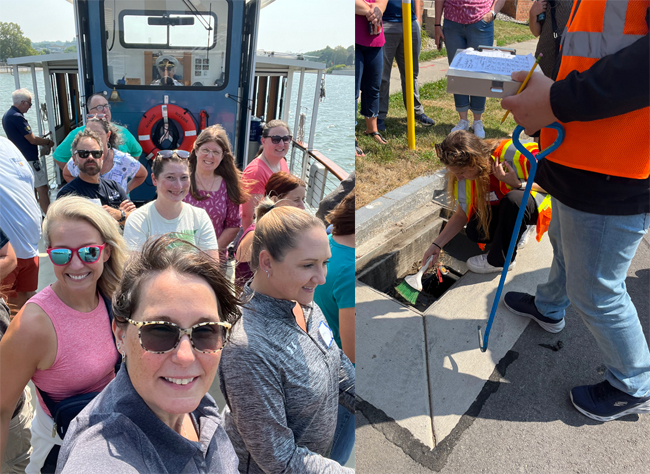
Educators at this summer 2025 workshop, held on August 14th at the Rochester Institute of Technology and along the Genesee River, (at left) toured LittaTraps in city storm drains, visited the lab, and (at right) headed out on a boat to explore plastic pollution solutions. Credit: Nate Drag/NYSG
Plastic Pollution in the Great Lakes – CASCADE Curriculum Workshop
The Community Action for Stormwater Clean-up and Debris Elimination (CASCADE) Curriculum Workshop, which is part of a NOAA Marine Debris Program funded research project, was facilitated by Drag, NYSG Water Quality Extension Specialist Jake Anderson, and educators and researchers from the Rochester Institute of Technology (RIT). This workshop brought sixteen participants from New York communities to Rochester, NY, to learn how researchers, educators and community members have been collaborating to reduce plastic pollution in the Great Lakes.
“This workshop provided a perfect opportunity to share the work we have been doing in Rochester for the last couple years with teachers across the Great Lakes region of New York,” said Anderson, describing the event. “We demonstrated a few CASCADE activities we have developed, and I am excited to see how the teachers can adapt these activities and the CASCADE program into their own classrooms!”
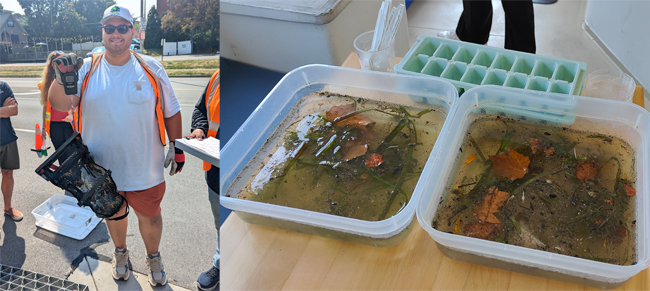
Participants at the CASCADE Curriculum Workshop in Rochester, NY who toured LittaTraps in city storm drains were joined by (at left) Jake Anderson, NYSG's Water Quality Extension Specialist, and (at right) examined the contents of those LittaTraps in the lab. Credit: Nate Drag/NYSG
The workshop began on RIT’s campus, where Dr. Christy Tyler and Dr. Matt Hoffman introduced their research on plastic pollution in the Great Lakes and Litta Traps, a device they are using to collect and analyze litter in local communities’ stormwater drains. Participants received an up-close view of the labs where the samples from the Litta Traps are processed, and were able to participate in the process by sorting and counting plastic pollution in Litta Trap samples. In the afternoon, educators were taken on the Riverie Tour Boat, where they had the opportunity to participate in plastic pollution activities that they could facilitate with their students in the classroom. To end the day, the teachers visited several Litta Traps installed in Rochester neighborhoods to work with the research team to collect samples directly from the storm drains.
The workshop provided educators with tools and resources to help encourage their students to combat a global challenge through local actions.
“This workshop was fantastic – the best one of the summer, actually,” one of the participants shared in a post-event survey. “It was a nice mix of activities, and it was great actually seeing trash and data collection put into practice with a goal of educating the public about the results of their actions.”
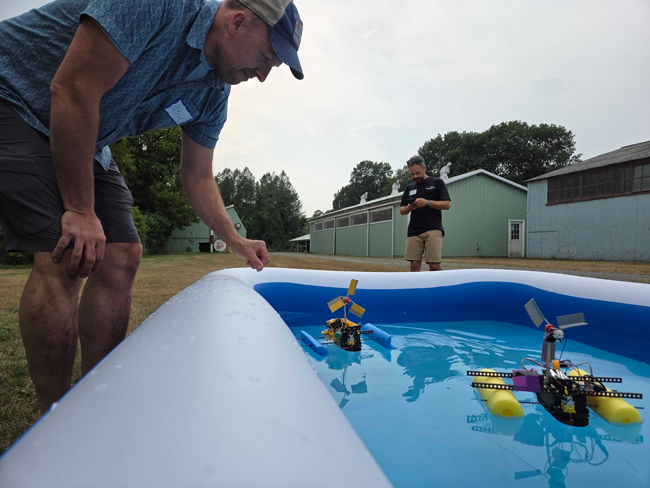
Educators at two day workshops held in early August at the Cornell Biological Field Station on Oneida Lake built their own miniature motorized boats. Credit: Nate Drag/NYSG
Combating Microplastics Through Robotics – Mollusca Curriculum Development Workshop
The Mollusca Curriculum Development Workshop, part of a NOAA Marine Debris Grand Challenge Research Project, brought teachers from as far apart as Buffalo and Long Island to Cornell University’s Biological Field Station on Oneida Lake. Prior to coming together this summer, these teachers had been meeting online with Drag and researchers at Cornell University, Princeton University, and the University of Michigan to understand the challenge of microplastic pollution. They also learned about how the multi-institute research team has been taking a lesson from nature to develop an innovative microplastic collecting robot based on the Hawaiian apple snail.
At the workshop this summer, participating educators had the opportunity to construct and code their own prototypes of the microplastic-collecting robot, tour the field station to learn more about ongoing research projects, practice sampling the water surface for microplastics, and work together to develop plans for bringing this project — and the robot — back to their schools.
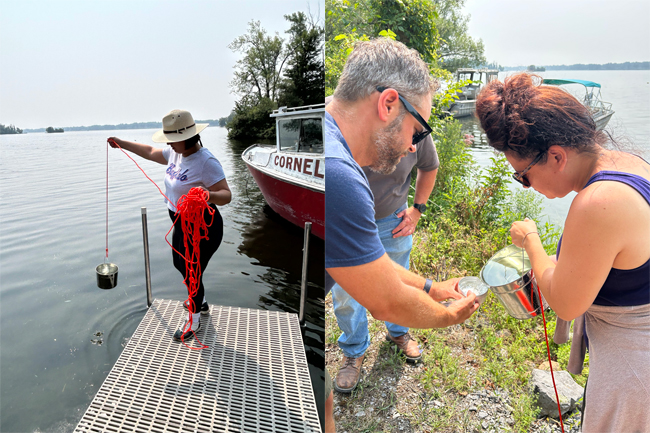
During the two day workshops held in early August at the Cornell Biological Field Station on Oneida Lake, participants learned about innovative research, inspired by the Hawaiian apple snail, that has led to a robot prototype designed to collect microplastics from the water’s surface. Credit: Nate Drag/NYSG
"It was a privilege to work with teachers from across New York State during this summer workshop,” said Dr. Maha Haji, a Visiting Assistant Professor of Mechanical, Aerospace, and Systems Engineering at MIT. “We appreciated the opportunity to share the science and engineering behind our bio-inspired robot and to develop a curriculum on both microplastic pollution and marine robotics. Bringing this technology into the classroom not only helps students learn science and engineering principles, but also challenges them to apply this knowledge to real environmental issues. We look forward to seeing how these teachers will use the project to inspire the next generation of problem-solvers."
By the end of the workshop, educators felt prepared to bring STEM-inspired curriculum based on their experience into the classroom.
“I learned so much [at this workshop] and have decided to switch my Environmental Science curriculum from a more general approach to specifically focusing on the Great Lakes,” one participant shared. A different educator added that the experience – especially getting to tour the field station – made them feel like “a real scientist.”
Despite how different each workshop was, one thing is clear – they gave educators an unforgettable experience to bring back to the classroom. A comment from one participant sums up the overall experience: “I will be taking as many of these workshops as possible!”
More Info: New York Sea Grant
Established in 1966, the National Oceanic and Atmospheric Administration (NOAA)’s National Sea Grant College Program promotes the informed stewardship of coastal resources in 34 joint federal/state university-based programs in every U.S. coastal state (marine and Great Lakes) and Puerto Rico. The Sea Grant model has also inspired similar projects in the Pacific region, Korea and Indonesia.
Since 1971, New York Sea Grant (NYSG) has represented a statewide network of integrated research, education and extension services promoting coastal community economic vitality, environmental sustainability and citizen awareness and understanding about the State’s marine and Great Lakes resources.
NYSG historically leverages on average a 3 to 6-fold return on each invested federal dollar, annually. We benefit from this, as these resources are invested in Sea Grant staff and their work in communities right here in New York.
Through NYSG’s efforts, the combined talents of university scientists and extension specialists help develop and transfer science-based information to many coastal user groups—businesses and industries, federal, state and local government decision-makers and agency managers, educators, the media and the interested public.
New York Sea Grant, one of the largest of the state Sea Grant programs, is a cooperative program of the State University of New York (SUNY) and Cornell University. The program maintains Great Lakes offices at Cornell University, SUNY Buffalo, Rochester Institute of Technology, SUNY Oswego, the Wayne County Cooperative Extension office in Newark, and in Watertown. In the State's marine waters, NYSG has offices at Stony Brook University and with Cornell Cooperative Extension of Nassau County on Long Island, in Queens, at Brooklyn College, with Cornell Cooperative Extension in NYC, in Bronx, with Cornell Cooperative Extension of Ulster County in Kingston, and with Cornell Cooperative Extension of Westchester County in Elmsford.
For updates on Sea Grant activities: www.nyseagrant.org, follow us on social media (Facebook, Twitter/X, Instagram, Bluesky, LinkedIn, and YouTube). NYSG offers a free e-list sign up via www.nyseagrant.org/nycoastlines for its flagship publication, NY Coastlines/Currents, which it publishes 2-3 times a year.