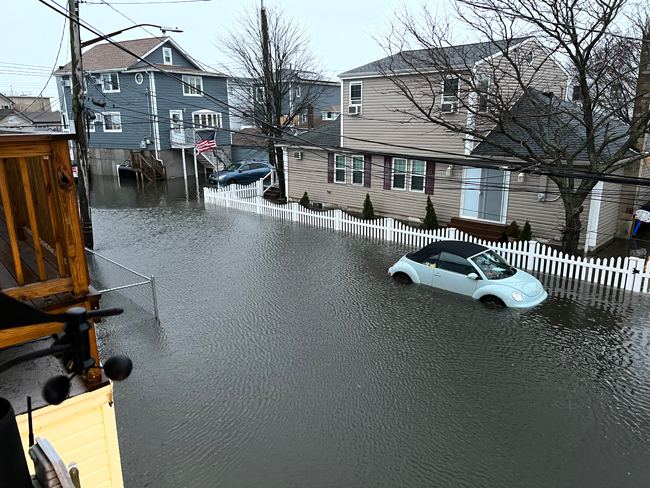
A view of a partially submerged car taken looking east on E. 7th Rd. Credit: Martin Grillo
— By Sumayyah Uddin, NYSG's Science Writer
Contact:
Hannah Burnett, NYSG Coastal Resilience Extension Specialist, E: heb84@cornell.edu, P: (718) 841-7609
Brooklyn, NY, October 15, 2025 - After six meetings over three months, each participant in the Community Flood Fellowship program presented research and information about flooding in their communities throughout the Jamaica Bay region.
Also during the Community Flood Forum and Resource Fair, which was held at the Idlewild Environmental Science Center in Springfield Gardens, NY, several community and government agencies provided information on flood resilience in New York City neighborhoods. Stakeholders and attendees engaged in networking opportunities and also toured the Center’s animal exhibits.
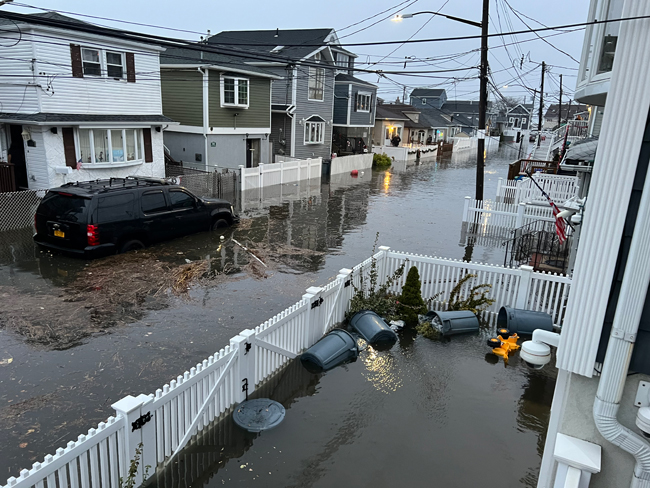
A view of yards and a partially submerged car taken looking west on E. 7th Rd. Credit: Martin Grillo
What is the Community Flood Fellowship Program?
The Jamaica Bay Community Flood Fellowship Program was piloted in 2024 by New York Sea Grant in collaboration with CUNY’s Science and Resilience Institute of Jamaica Bay with support from NOAA, in order to bring together leaders from flood-affected communities in the NYC region and build local knowledge about flooding across communities. In 2025, the program continued with funding from FEMA, with the Flood Fellowship Program supporting thirteen community Fellows. This is a train-the-trainer program that builds a community-based understanding of flood resilience and equips participants to teach their communities about resources and tools related to flooding, including MyCoast NY Flood Watch.
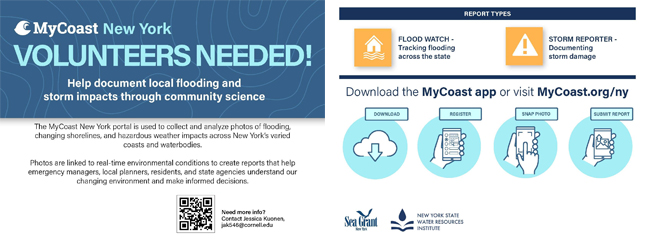
The MyCoast New York portal — developed by New York Sea Grant and the Cornell's New York State Water Resources Institute — is a photo-sharing platform where New Yorkers can upload pictures of flooding, storm impacts, litter, and more to help track and understand changes in our waterways. Learn more and download the MyCoast app on your mobile device: https://mycoast.org/ny
“Since 2018, we [at New York Sea Grant] have been working on the NYC Community Flood Watch Project, where we work with residents to take photos of flooding in their neighborhoods to build a public flood photo database,” said Hannah Eisler Burnett, the Jamaica Bay Coastal Resilience Specialist for NYSG. “There was a real need for a space where communities facing similar types of flooding within the watershed could come together and learn from each other, and for us to learn from them too. We wanted to create an opportunity for people doing neighborhood-level work on flooding to share knowledge and strategies, learn about tools and resources for understanding flooding, and then share what they learned with others in their community to increase general capacity around flooding issues.”
This need directly led to the development of the Flood Fellowship program, the next step in building flood resilience in the Jamaica Bay watershed of NYC.
“We tried to create a network of community leaders who are working on issues related to flooding or who want to work on issues related to flooding,” Burnett explained. “That way, they can be informed, know each other and form a network where they can support each other in this work.”
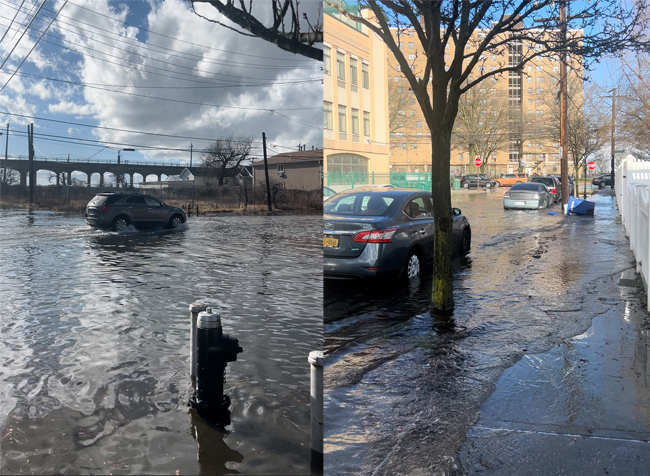
Photos taken in Edgemere, Queens, on Julien's residential block on Beach 41st Street and Rockaway Beach Boulevard. (at left) A car drives through floodwaters on Beach 41st Street and Rockaway Beach Boulevard. (at right) A picture of the flooded Beach 41st Street, located between Rockaway Beach Boulevard and Beach Channel Drive. Credit: Mel Julian
The Fellows in Action
The 13 participants in the 2025 Community Flood Fellows Program represented a broad spectrum of NYC communities affected by flooding. Fellows worked in a variety of different roles alongside their time in the program, ranging from a position in sustainable construction (Shantae Johnson) to serving as the Community Engagement Director of the NYC Plover Project (Mel Julian). The projects were similarly diverse, focusing on topics like infrastructure, supporting natural and nature-based shorelines, and implementing both short- and long-term solutions to protect flood-prone communities.
“As Vice President of the Springfield Rosedale Community Action Association (SRCAA) and a longtime homeowner in Brookville, a wetland community, I have firsthand experience with the growing impacts of flooding,” said Latanya Collins, a former K-12 science educator who now serves as leader on multiple community groups’ committees. “My culminating project explored nature-based solutions for flood prevention both locally and globally, focusing on the role of green infrastructure, wetlands, and community-driven strategies in building long-term resilience.”
Other fellows were interested in different angles of the flooding problem. Gloria Martindale, a retired Brooklyn teacher who is now a representative of the Garden of the Bay community garden in the Edgemere neighborhood of the Rockaway Peninsula, used her presentation as an opportunity to talk about upgrading old infrastructure that leads to problems like “sunny-day flooding” (temporary flooding that happens during high tide rather than after a heavy rainstorm). She dedicated part of her presentation to explaining how tidal and lunar charts might be used to predict flooding before it occurs.
“During phases where the moon and sun are aligned with Earth, they’ll have the greatest gravitational pull,” she explained, demonstrating on her accompanying tidal chart. “If you’re armed with that type of information ahead of time, you can kind of predict that this might be a time where we may have some trouble — a time where I may start thinking about [securing] my basement.”
Other presenters highlighted more problems (and solutions) around flooding: problems posed by compound flooding, which is when two or more flood factors are present simultaneously (presented by Sandra Long); the need for a combination of short- and long-term solutions, such as green infrastructure and flood barriers, to protect a flood-prone road that is an important pathway through neighborhoods (presented by Latanya Collins); and examining solutions to flooding through natural and nature-based shorelines through work with the Billion Oyster Project (presented by Paola Garcia).
What’s Next For the Fellows
The Community Flood Forum was intended to help showcase the fellows’ hard work, but it is hardly the end of the Program for the attendees. Many fellows were already immersed in environmental initiatives in their neighborhoods, and were already planning next steps to continue combating flooding in their communities.
“Participating in the Jamaica Bay Flood Fellowship program was a rewarding experience. [What] made this fellowship especially impactful was the community-centered design of the resources provided,” noted Garcia, one of the 2025 Flood Fellows. “The tools and materials were genuinely created for community engagement, enabling me to extend the fellowship's value far beyond our cohort. I've shared these resources across my network, from my friends, family, and work circles, to my neighbors and building superintendent!”
“We’re in our second year [in the program]; last year was the pilot. It has been a great example of community-driven identification of solutions to local flooding, with everyone supporting each other’s work,” Eisler Burnett said on the success of the program. “I think a lot of the work going forward will be about highlighting opportunities that arise through New York Sea Grant [so that they can] stay involved in aspects of the work that speak to individual fellows and distinct neighborhood or community needs.”
See the full list of 2025 Community Flood Fellows and their biographies here.
More Info: New York Sea Grant
Established in 1966, the National Oceanic and Atmospheric Administration (NOAA)’s National Sea Grant College Program promotes the informed stewardship of coastal resources in 34 joint federal/state university-based programs in every U.S. coastal state (marine and Great Lakes) and Puerto Rico. The Sea Grant model has also inspired similar projects in the Pacific region, Korea and Indonesia.
Since 1971, New York Sea Grant (NYSG) has represented a statewide network of integrated research, education and extension services promoting coastal community economic vitality, environmental sustainability and citizen awareness and understanding about the State’s marine and Great Lakes resources.
NYSG historically leverages on average a 3 to 6-fold return on each invested federal dollar, annually. We benefit from this, as these resources are invested in Sea Grant staff and their work in communities right here in New York.
Through NYSG’s efforts, the combined talents of university scientists and extension specialists help develop and transfer science-based information to many coastal user groups—businesses and industries, federal, state and local government decision-makers and agency managers, educators, the media and the interested public.
New York Sea Grant, one of the largest of the state Sea Grant programs, is a cooperative program of the State University of New York (SUNY) and Cornell University. The program maintains Great Lakes offices at Cornell University, SUNY Buffalo, Rochester Institute of Technology, SUNY Oswego, the Wayne County Cooperative Extension office in Newark, and in Watertown. In the State's marine waters, NYSG has offices at Stony Brook University and with Cornell Cooperative Extension of Nassau County on Long Island, in Queens, at Brooklyn College, with Cornell Cooperative Extension in NYC, in Bronx, with Cornell Cooperative Extension of Ulster County in Kingston, and with Cornell Cooperative Extension of Westchester County in Elmsford.
For updates on Sea Grant activities: www.nyseagrant.org, follow us on social media (Facebook, Twitter/X, Instagram, Bluesky, LinkedIn, and YouTube). NYSG offers a free e-list sign up via www.nyseagrant.org/nycoastlines for its flagship publication, NY Coastlines/Currents, which it publishes 2-3 times a year.