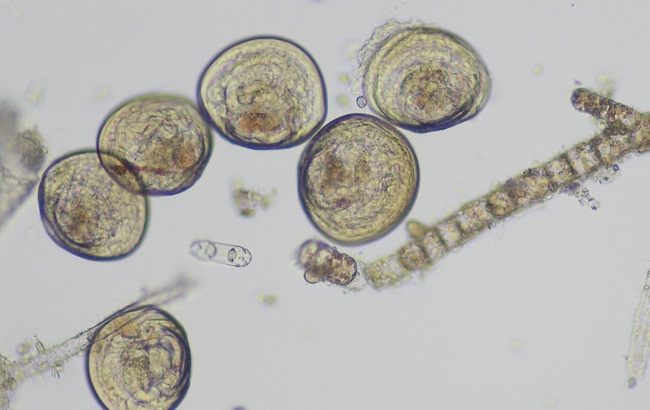
Surfclam larvae along side some of the phytoplankton that is consumed by their adult conspecifics (members of the same species). Credit: Raymond Czaja
— By Chris Gonzales, Freelance Writer, New York Sea Grant
Contact:
Lane Smith, Research Program Coordinator, NYSG, E: lane.smith@stonybrook.edu, P: (631) 632-9780
Changes in seasonal temperature may be affecting ocean life, in some cases years after exposure
Stony Brook, NY, January 9, 2025 - Changes in seasonal temperature may be affecting ocean life, in some cases years after exposure in impacts which scientists call “carryover effects.” One organism that could be affected is the iconic surfclam, an economically important shellfish.
The Atlantic surfclam, Spisula solidissima solidissima, a bivalve, is particularly interesting when it comes to climate change, growing up to eight inches in length, providing useful benefits to the environment1,and serving as a valuable source of food for humans and other animals. The shells of these organisms are a common sight to beachgoers in the northeastern United States2. Clams, like other invertebrates, are ectothermic animals, which means their body temperature matches that of the environment. Many bivalves, including surfclams, are broadcast spawners, meaning they release their gametes into the water, typically after building up gonad reserves for at least one spring season. Every aspect of the life of a surfclam—including feeding, growth, and reproduction—is linked to environmental temperatures.
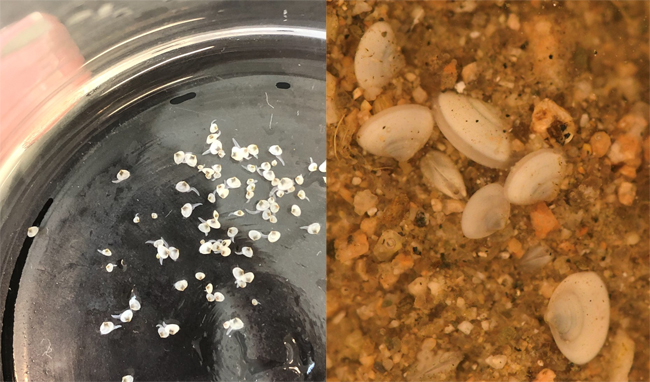
(At left) Recently settled surfclams in a petri dish; (At right) Recently settled surfclams burrowing into sediment. Credit: Raymond Czaja
“Our team is evaluating the effects of current and future climate conditions on surfclam populations in the New York Bight,” said Dr. Bassem Allam, a professor at Stony Brook University’s School of Marine and Atmospheric Sciences and one of the authors of a recent paper3. “We are unraveling the impact of factors such as seawater temperature and acidity on surfclam feeding activities, metabolism, growth, and survival.”
This study was part of a suite of research projects funded by New York Sea Grant (NYSG) and the New York State Department of Environmental Conservation (DEC). In 2019, these organizations announced awards to three investigative teams, at Stony Brook University (SBU), CUNY York College, and the Wildlife Conservation Society.
These projects focused on objectives such as studying the impacts of ocean acidification on shellfish, crustaceans, fish, and zooplankton in the New York Bight; and, given an increase in global temperatures and potential ocean acidification, investigating the impacts to the shellfish fishery and other ecosystems.
Economic Implications
Several components of New York’s economy rely heavily on the state’s ocean and estuarine ecosystems, including maritime shipping, commercial and recreational fishing, and tourism.
Ocean warming is one of many factors in ectotherm survival, in addition to food availability and feeding behavior. For bivalves, particularly suspension feeders, their food is seston, often in the form of phytoplankton—microscopic single-celled algae that provide food at the most basic level in the marine food web4. Yet ocean warming might also help these heat-sensitive organisms flourish — at least in the short term.
Surfclams primarily take their food from the phytoplankton community, as do many other ocean creatures. But phytoplankton populations are expected to shift with climate change. Today, these populations tend to be dominated by diatoms, which bivalves preferentially “clear,” or digest. Scientists are concerned that these populations might give way to nanoplankton communities, which are not preferentially cleared5, yet they are not certain how and when different plankton populations might shift.

(At left) Holding tank used for adult surfclams during the carryover experiments; (At right) Individual tanks used for adult surfclams during the feeding experiments. Credit: Raymond Czaja
Multiple Factors
Scientists on the team measured a variety of physiological responses, including growth, gonad development, feeding behavior, and preferences for different phytoplankton groups for food, and assessed how temperature may affect these responses. These findings will help scientists develop more accurate computer models of how ocean warming may affect food uptake, and therefore growth, survival, and reproduction.
In addition, these feeding experiments show that the type of food and how it is cleared is driven by the ups and downs of temperature and food availability.
Complementary experiments, meanwhile, showed that elevated temperature regimes “carryover” into the next season, and the season after that. These carryover effects can include more rapid gonad development in the surfclam the following spring, as suggested by their results.
The rapid growth of gonads and increased filtration rate (akin to a feeding rate) as well as more surfclams reaching spawning may be related to increased energy acquisition due to elevated temperatures.
In short, scientists may have identified a temporary and short-lived energizing effect of a warming ocean. That is, an effect that will vanish when temperatures exceed 20 degrees Celsius, when surfclams start to become stressed.
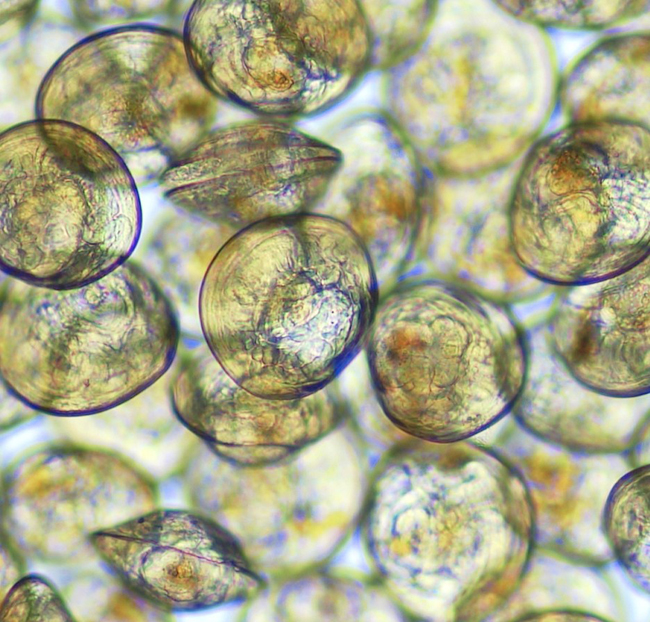
Surfclam larvae. Credit: Raymond Czaja
Conclusion
These results pose interesting questions for the surfclam fishery. Carryover effects of climate change conditions are frequently studied, but carryover effects within generations or within life stages are not.
“Research is ongoing to integrate data obtained from laboratory experiments on larval swimming behavior and survival into biophysical model simulations to identify hotspots of larval settlement,” Allam said, referring to a key part of the bivalve reproductive cycle. “These models will inform ocean health monitoring efforts and optimize the management of shellfish resources in the state and the region.”
Scientists believe that changes in feeding behavior such as these may also affect growth at the individual and possibly the population level.
"We know a lot about how and why bivalves eat and what they eat,” said Raymond Czaja, a recent PhD student at Stony Brook University and lead author of the paper. “But we know less about how climate change affects this behavior and these decisions, so to speak."
Only by studying multiple factors at once—feeding, growth, reproduction, and so on—are scientists getting an accurate picture of what things might look like for the iconic surfclam in a hotter future.
References
1 Atlantic Surfclam | NOAA Fisheries Accessed July 24, 2024.
2 Atlantic surf clam - Wikipedia Accessed July 24, 2024.
3 Czaja, R. et al. “Carryover effects and feeding behavior of Atlantic surfclams in response to climate change.” Journal of Experimental Marine Biology and Ecology 573 (2024) 152002 Accessed October 14, 2024.
4 Phytoplankton of the Northwest U.S. Shelf Ecosystem | NOAA Fisheries Accessed July 10, 2024.
5 Bivalve Aquaculture Carrying Capacity: Concepts and Assessment Tools | SpringerLink Accessed October 15, 2024.
More Info: New York Sea Grant
Established in 1966, the National Oceanic and Atmospheric Administration (NOAA)’s National Sea Grant College Program promotes the informed stewardship of coastal resources in 34 joint federal/state university-based programs in every U.S. coastal state (marine and Great Lakes) and Puerto Rico. The Sea Grant model has also inspired similar projects in the Pacific region, Korea and Indonesia.
Since 1971, New York Sea Grant (NYSG) has represented a statewide network of integrated research, education and extension services promoting coastal community economic vitality, environmental sustainability and citizen awareness and understanding about the State’s marine and Great Lakes resources.
NYSG historically leverages on average a 3 to 6-fold return on each invested federal dollar, annually. We benefit from this, as these resources are invested in Sea Grant staff and their work in communities right here in New York.
Through NYSG’s efforts, the combined talents of university scientists and extension specialists help develop and transfer science-based information to many coastal user groups—businesses and industries, federal, state and local government decision-makers and agency managers, educators, the media and the interested public.
New York Sea Grant, one of the largest of the state Sea Grant programs, is a cooperative program of the State University of New York (SUNY) and Cornell University. The program maintains Great Lakes offices at Cornell University, SUNY Buffalo, Rochester Institute of Technology, SUNY Oswego, the Wayne County Cooperative Extension office in Newark, and in Watertown. In the State's marine waters, NYSG has offices at Stony Brook University and with Cornell Cooperative Extension of Nassau County on Long Island, in Queens, at Brooklyn College, with Cornell Cooperative Extension in NYC, in Bronx, with Cornell Cooperative Extension of Ulster County in Kingston, and with Cornell Cooperative Extension of Westchester County in Elmsford.
For updates on Sea Grant activities: www.nyseagrant.org, follow us on social media (Facebook, Twitter/X, Instagram, Bluesky, LinkedIn, and YouTube). NYSG offers a free e-list sign up via www.nyseagrant.org/nycoastlines for its flagship publication, NY Coastlines/Currents, which it publishes 2-3 times a year.