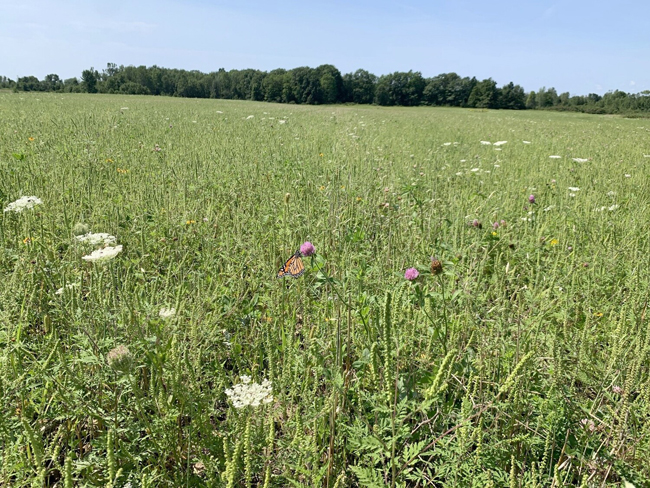
A past NY Great Lakes Basin Small Grants award provided funding to the Thousand Islands Land Trust to restore more than 155 acres of former farmland to native grassland, enhancing habitat for grassland-nesting birds and wintering raptors. Credit: Thousand Islands Land Trust
Contact:
Megan Cochran, NYSG Great Lakes Outreach Coordinator, E: mk2236@cornell.edu, P: (716) 270-2490
$2 Million Invested Since 2015 to Support Projects that Enhance the Health and Resilience of New York State’s Great Lakes Lands and Waters
Buffalo, NY, July 22, 2025 - The New York State Department of Environmental Conservation (DEC) and New York Sea Grant (NYSG) today announced $199,696 in grants for five Great Lakes basin projects. The initiatives support local community plans to restore water quality, protect ecosystems, and strengthen community resilience and stewardship. These selected projects support measurable progress toward the priority goals of the Great Lakes Action Agenda for New York’s Great Lakes watershed.
“New York’s Great Lakes Basin Small Grants support local science-based projects that restore habitats, combat invasive species, and engage communities while strengthening the resilience of our shared environment and the State’s economy,” DEC Commissioner Amanda Lefton said. “Through partnerships like this with New York Sea Grant, DEC is advancing the goals of the Great Lakes Action Agenda and delivering real, measurable results.”
“New York’s Great Lakes Basin Small Grants support local efforts to restore and revitalize the natural features that are vital infrastructure for their communities and economies,” New York Sea Grant Associate Director and Cornell University Cooperative Extension Assistant Director Katherine Bunting-Howarth, PhD, JD, said. “The projects apply a holistic approach that recognizes the dynamic interaction of ecological, social, and economic systems.”
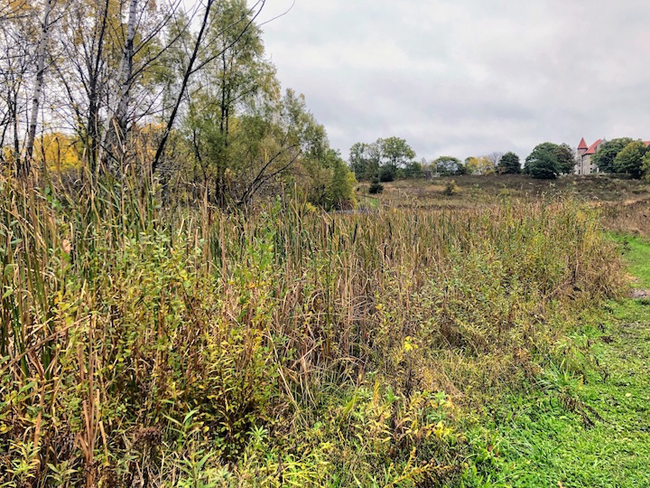
A past New York Great Lakes Basin Small Grants award provided funding to the Western New York Land Conservancy to restore approximately 1.5 acres of sedge meadow and wet-mesic grassland habitat at the Stella Niagara Preserve along the Niagara River. Credit: Western New York Land Conservancy
New York’s Great Lakes Basin Small Grants program has awarded more than $2 million in small grants to date for a combined total of 66 projects since the program’s inception in 2015. The five projects selected for this round of New York’s Great Lakes Basin Small Grants funding include:
Erie County
Buffalo Niagara Waterkeeper: $40,000 for “Sheridan Park Living Shoreline” to implement a living shoreline restoration at Sheridan Park in the Town of Tonawanda. This project will transform 6.75 acres and more than 2,700 linear feet of degraded land along Two Mile Creek into a resilient and ecologically functional riparian area.
Erie County
Western New York Land Conservancy: $40,000 for “Addressing Common Invasive Species in Western New York Forests with Education for Forest Landowners” to restore 49 acres at Kenneglenn Scenic Nature Sanctuary and Mossy Point Preserve. This project will include invasive plant species management and programming workshops to educate local forest landowners about invasive species identification and management strategies.
Genesee County
Genesee County Parks: $39,753 for “Healthy Headwaters: Empowering Youth to Restore Riparian Habitat in the Upper Black Creek Watershed” to restore 140 linear feet of riparian habitat in the headwaters area of the Upper Black Creek watershed, using ecosystem-based management techniques and nature-based solutions that reduce erosion in Genesee County Park and Forest. The project will engage a coalition of community organizations plus 200 youth and 25 adult volunteers, in hands-on restoration and education to build stewardship and inspire future environmental leaders.
Jefferson County
Cornell Cooperative Extension of Jefferson County: $40,000 for “Seeds of Stewardship: Community-Based Native Seed Network for the Northeast Lake Ontario and St. Lawrence River Region” to launch a native seed collection and propagation program across Jefferson, Lewis, and St. Lawrence counties. The project will train volunteers, develop local seed storage and propagation infrastructure, and utilize native plant material to support habitat restoration and resilience.
Oswego County
Atlantic States Legal Foundation: $39,943 for “A Community-Driven Tree Planting Initiative for Adaptation and Revitalization in Pulaski” to engage residents and partners in planning and planting more than 70 trees in priority locations throughout the village of Pulaski, reducing risks such as flooding and heat stress, enhancing ecosystem services, and supporting long-term environmental stewardship. Guided by the Richland-Pulaski Comprehensive Plan and Climate Action Plan and three inclusive community workshops, residents and local partners will help identify strategic planting locations, develop site-specific plans, and learn about the social, ecological, and economic benefits of trees.
New York Sea Grant, a cooperative program of Cornell University and the State University of New York, administers the program in partnership with DEC’s Great Lakes Program. The program is funded through the New York State Environmental Protection Fund (EPF) and Article 14: the New York Ocean and Great Lakes Ecosystem Conservation Act outlined in the EPF. The 2025-26 enacted State Budget increases the EPF?to a record $425 million, helping support critical environmental programs such as land acquisition, farmland protection, invasive species prevention and eradication, enhanced recreational access, water quality improvement, and an aggressive environmental justice agenda.
For more information about these projects and previous funding rounds, visit nyseagrant.org/glsmallgrants.
Learn more about the New York’s Great Lakes Action Agenda that applies ecosystem-based management to conserve, protect, and enhance New York State’s Great Lakes natural resources on DEC’s website.
More Info: New York Sea Grant
Established in 1966, the National Oceanic and Atmospheric Administration (NOAA)’s National Sea Grant College Program promotes the informed stewardship of coastal resources in 34 joint federal/state university-based programs in every U.S. coastal state (marine and Great Lakes) and Puerto Rico. The Sea Grant model has also inspired similar projects in the Pacific region, Korea and Indonesia.
Since 1971, New York Sea Grant (NYSG) has represented a statewide network of integrated research, education and extension services promoting coastal community economic vitality, environmental sustainability and citizen awareness and understanding about the State’s marine and Great Lakes resources.
NYSG historically leverages on average a 3 to 6-fold return on each invested federal dollar, annually. We benefit from this, as these resources are invested in Sea Grant staff and their work in communities right here in New York.
Through NYSG’s efforts, the combined talents of university scientists and extension specialists help develop and transfer science-based information to many coastal user groups—businesses and industries, federal, state and local government decision-makers and agency managers, educators, the media and the interested public.
New York Sea Grant, one of the largest of the state Sea Grant programs, is a cooperative program of the State University of New York (SUNY) and Cornell University. The program maintains Great Lakes offices at Cornell University, SUNY Buffalo, Rochester Institute of Technology, SUNY Oswego, the Wayne County Cooperative Extension office in Newark, and in Watertown. In the State's marine waters, NYSG has offices at Stony Brook University and with Cornell Cooperative Extension of Nassau County on Long Island, in Queens, at Brooklyn College, with Cornell Cooperative Extension in NYC, in Bronx, with Cornell Cooperative Extension of Ulster County in Kingston, and with Cornell Cooperative Extension of Westchester County in Elmsford.
For updates on Sea Grant activities: www.nyseagrant.org, follow us on social media (Facebook, Twitter/X, Instagram, Bluesky, LinkedIn, and YouTube). NYSG offers a free e-list sign up via www.nyseagrant.org/nycoastlines for its flagship publication, NY Coastlines/Currents, which it publishes 2-3 times a year.