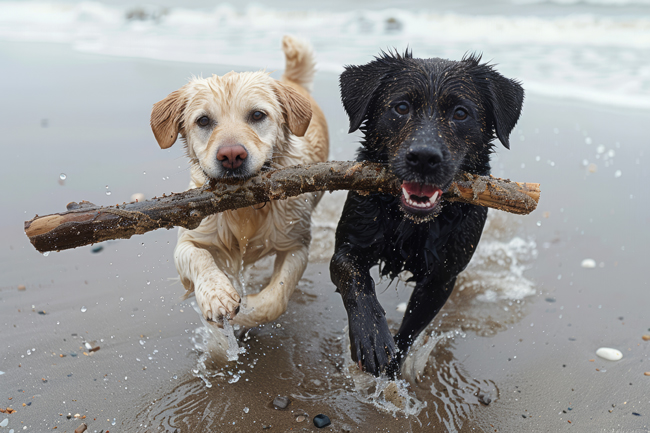
New York Sea Grant has issued updated information to help dog owners protect their pets from exposure to harmful algal blooms. According to the American Veterinary Medical Association, 4.5 percent of U.S. households were home to at least one dog in 2024.
Contacts:
Stacy Furgal, New York Sea Grant Great Lakes Fisheries and Ecosystem Health Specialist, P: 315-312-3042, E: slf85@cornell.edu
Kara Lynn Dunn, NYSG Great Lakes Publicist, P: 315-465-7578, E: karalynn@gisco.net
Oswego, NY, July 8, 2025 - To help dog owners protect their pets from toxic algal blooms, New York Sea Grant has published a newly-revised "Protect Your Dog from Harmful Algae" brochure. The publication, freely available at nyseagrant.info/dogsandhabsbrochure (pdf), includes:
• signs of harmful algae that can occur in waters from small puddles to large lakes,
• indications of harmful algal blooms (HAB) poisoning in your pet,
• tips for reducing the risk of exposure,
• pet emergency hotline contacts in New York state, and
• New York State Department of Environmental Conservation and Department of State websites for reporting waters that may have a harmful algal bloom.
"You cannot tell if a bloom is toxic by looking, but there are signs to watch for on the water as well as potentially impacted debris on shore. Additionally, knowing the signs and symptoms of harmful algae poisoning in dogs can help pet owners act quickly to seek immediate veterinary help," says New York Sea Grant Great Lakes Fisheries and Ecosystem Health Specialist Stacy Furgal.
Furgal updated the informational brochure with assistance from Cornell University Richard P. Riney Canine Health Center Extension Veterinarian Aly Cohen, D.V.M.
Dr. Cohen notes, "The harmful form of algal blooms is caused by overgrowth of cyanobacteria, often called blue-green algae, that produces toxins harmful to people, pets, waterfowl, and livestock. Water sample testing is required to confirm that harmful algae is present. This outreach by New York Sea Grant helps educate the public about the risk of HABs to dogs."
Pets and livestock can develop HABs poisoning by ingestion of HABs-infected water or shoreline debris and by grooming their fur and paws after being in water impacted by HABs. Symptoms of harmful algae poisoning in your dog may appear immediately or several hours after exposure.
Water with the potential for HABs may appear green, blue-green, brown, or red with a spilled paint pattern as well as have HAB-infected scum or mats of debris floating on the water or found along the shoreline.
More Info: New York Sea Grant
Established in 1966, the National Oceanic and Atmospheric Administration (NOAA)’s National Sea Grant College Program promotes the informed stewardship of coastal resources in 34 joint federal/state university-based programs in every U.S. coastal state (marine and Great Lakes) and Puerto Rico. The Sea Grant model has also inspired similar projects in the Pacific region, Korea and Indonesia.
Since 1971, New York Sea Grant (NYSG) has represented a statewide network of integrated research, education and extension services promoting coastal community economic vitality, environmental sustainability and citizen awareness and understanding about the State’s marine and Great Lakes resources.
NYSG historically leverages on average a 3 to 6-fold return on each invested federal dollar, annually. We benefit from this, as these resources are invested in Sea Grant staff and their work in communities right here in New York.
Through NYSG’s efforts, the combined talents of university scientists and extension specialists help develop and transfer science-based information to many coastal user groups—businesses and industries, federal, state and local government decision-makers and agency managers, educators, the media and the interested public.
New York Sea Grant, one of the largest of the state Sea Grant programs, is a cooperative program of the State University of New York (SUNY) and Cornell University. The program maintains Great Lakes offices at Cornell University, SUNY Buffalo, Rochester Institute of Technology, SUNY Oswego, the Wayne County Cooperative Extension office in Newark, and in Watertown. In the State's marine waters, NYSG has offices at Stony Brook University and with Cornell Cooperative Extension of Nassau County on Long Island, in Queens, at Brooklyn College, with Cornell Cooperative Extension in NYC, in Bronx, with Cornell Cooperative Extension of Ulster County in Kingston, and with Cornell Cooperative Extension of Westchester County in Elmsford.
For updates on Sea Grant activities: www.nyseagrant.org, follow us on social media (Facebook, Twitter/X, Instagram, Bluesky, LinkedIn, and YouTube). NYSG offers a free e-list sign up via www.nyseagrant.org/nycoastlines for its flagship publication, NY Coastlines/Currents, which it publishes 2-3 times a year.