NOTE: Since this announcement was originally filed in mid-February, New York Sea Grant (NYSG)'s finalists for the 2026 John A. Knauss Fellowship officially became fellows ahead of their June 1st start date. These three young professionals join their peers to work in either executive branch agencies or Congressional offices, advancing federal initiatives in coastal and marine science and policy issues.
Kate Blackwell is working in the office of Congressman James C. Moylan (Guam); Brianna Lounsbury is working with the U.S. House Natural Resources Committee; and Anna Mehlhorn is working in the Office of Science and Technology at NOAA Fisheries, where she serves as its Recreational Fisheries Partnership Program Coordination and Science Communications Fellow.
Contact:
Sumayyah Uddin, Science Writer, New York Sea Grant, E: sumayyah.uddin@stonybrook.edu, P: (631) 632-6956
Stony Brook, NY, February 12, 2026 – New York Sea Grant (NYSG) congratulates three finalists in the 47th class of Sea Grant's John A. Knauss Marine Policy Fellowship (Knauss Fellowship). Kate Blackwell (SUNY Stony Brook University), Anna Mehlhorn (Cornell University), and Brianna Lounsbury (SUNY College of Environmental Science and Forestry) are among the fellowship program’s 48 national finalists. Each incoming student brings a unique background in coastal science that will be used to further marine conservation efforts.
This spring, Blackwell, Mehlhorn and Lounsbury will join the other 2026 finalists from across the nation to virtually meet each other and interview with federal offices that work on or have interest in coastal and marine science and policy issues. They will then be placed in federal government (legislative and executive) offices in Washington, D.C., for one-year fellowships that begin in June 2026.
The Knauss Fellowship has supported over 1,762 fellows since its establishment in 1979, with many recipients going on to establish careers in nonprofit, public service, and academia. Over the course of the fellowship, the 2026 finalists will build their networks, receive mentorship, and participate in professional development opportunities while working in either executive branch agencies or Congressional offices. For the national perspective on the 2026 Knauss finalists, see Sea Grant Announces 2025-2026 Fellowship Selections.
“New York Sea Grant (NYSG) is thrilled to introduce Brianna, Kate, and Anna, the newest members of our Sea Grant family!” says Becky Shuford, director of New York Sea Grant. “These three remarkable Knauss Fellowship Finalists boast literally a world of experience and global adventures – each already having made tangible real-world impact from berths aboard U.S. Navy aircraft carriers, Antarctic research vessels, and canoes that travel adorned with messages from the past to the present.
As Brianna, Kate, and Anna embark on their latest journey to Washington, D.C., they are poised to continue to make waves in their own unique and inspiring ways as they gain new knowledge and skills through fellowship placements in the executive and legislative branches of the U.S. Government. Please read on to meet NYSG’s 2026 Knauss Fellows.”
NYSG’s 2026 Knauss Finalists: In Their Words
Kate Blackwell
SUNY Stony Brook University
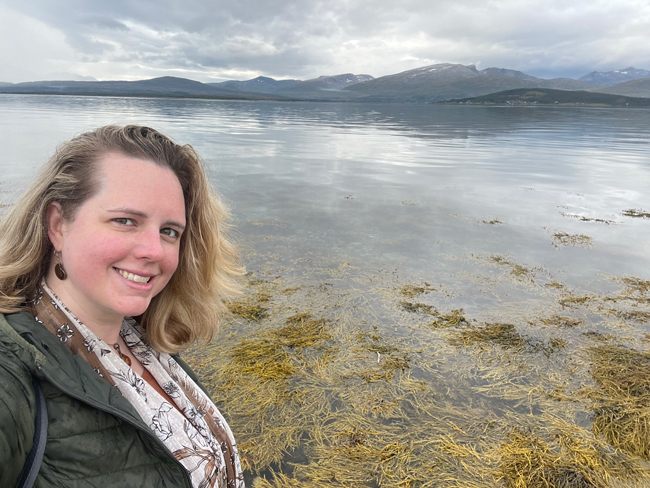
Kate Blackwell exploring the shoreline of Tromsø, Norway, just after arriving to begin her Fulbright Fellowship. Credit: Kate Blackwell
With an extensive background studying broader marine research already on her CV, Ph.D. candidate and Fulbright scholar Kate Blackwell sees the Knauss Fellowship as an opportunity to explore how science communication works at the federal level.
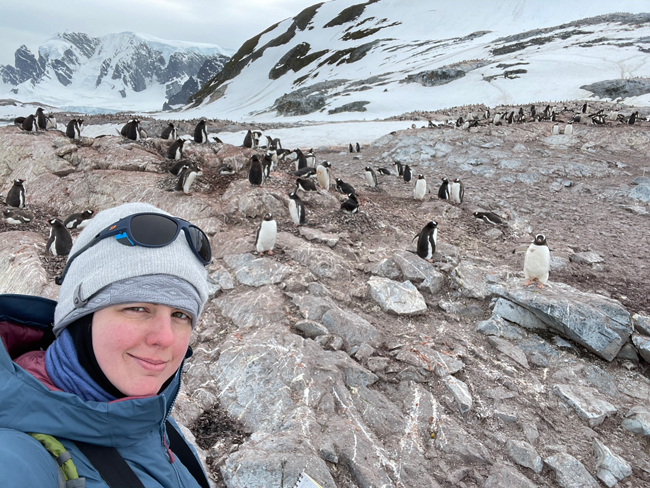
Blackwell counting Adélie penguins along the Antarctic peninsula during a field expedition. Credit: Kate Blackwell
Alongside her doctoral research in ecology and evolution and her graduate coursework, Blackwell gained experience in marine and coastal practices through internships on Atlantic sturgeon movements, deep-sea coral microbiomes, and marine mammal behavior. Being selected for the Knauss Fellowship aligns with Blackwell’s long-term goal to build a career “at the interface of marine science and policy” at an agency like the National Oceanic and Atmospheric Administration (NOAA) or the Environmental Protection Agency (EPA), where she can use her research to help further policy focused on practicable conservation and sustainable community use. She has a particular interest in “learning how agencies balance scientific recommendations with economic, diplomatic, and community considerations.”
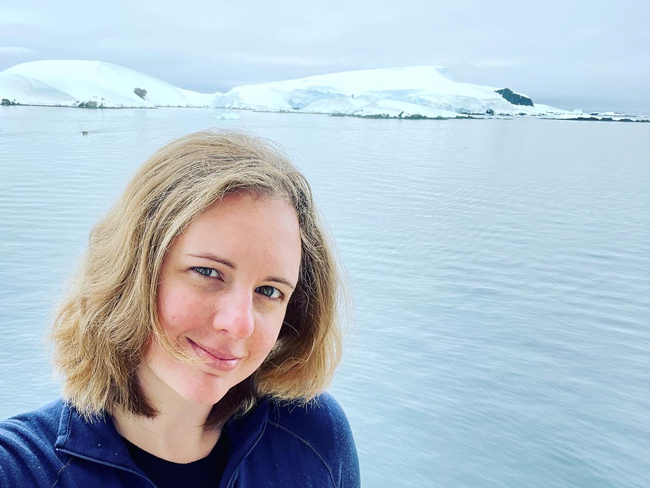
Blackwell on a field expedition to the Antarctic peninsula, on the vessel and making for the distant shore. Credit: Kate Blackwell
“I’m excited by the opportunity to delve more deeply into how scientific findings are evaluated, communicated, and ultimately integrated into federal decision-making,” Kate shared. “Because my background has focused on Antarctic and broader marine ecosystem research, I’m especially eager to see how issues such as ecosystem monitoring, conservation planning, and resource management are handled within federal agencies.”
Anna Mehlhorn
Cornell University
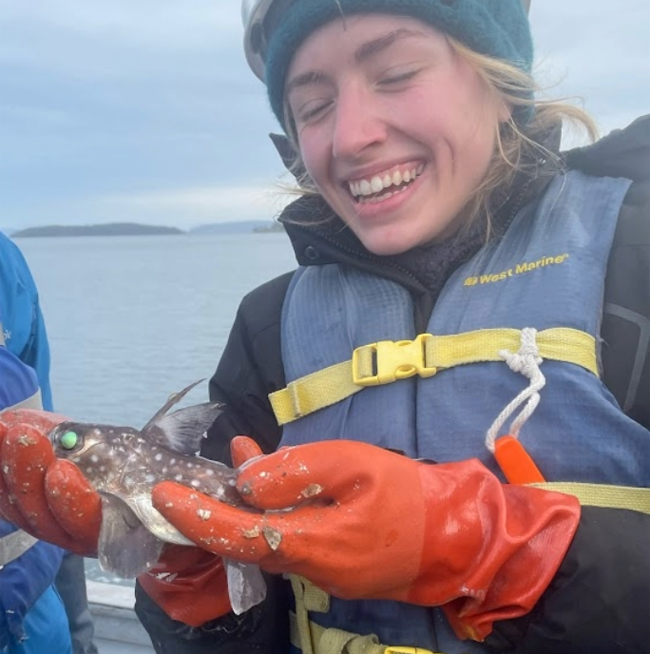
Anna Mehlhorn collecting deep-sea spotted ratfish (Hydrolagus colliei) off the coast of San Juan Island, Washington, for a fish swimming kinematics project. Credit: Anna Mehlhorn
Anna Mehlhorn, a graduate student in Natural Resources and the Environment, has accumulated a wealth of experience in aquatic ecology and environmental education. For several years, Mehlhorn has worked in coastal communities as a research assistant and field educator, using creative tools to communicate environmental messages and strengthen place-based connections. In these roles, she has also witnessed environmental challenges firsthand, like invasive species and sea-level rise.
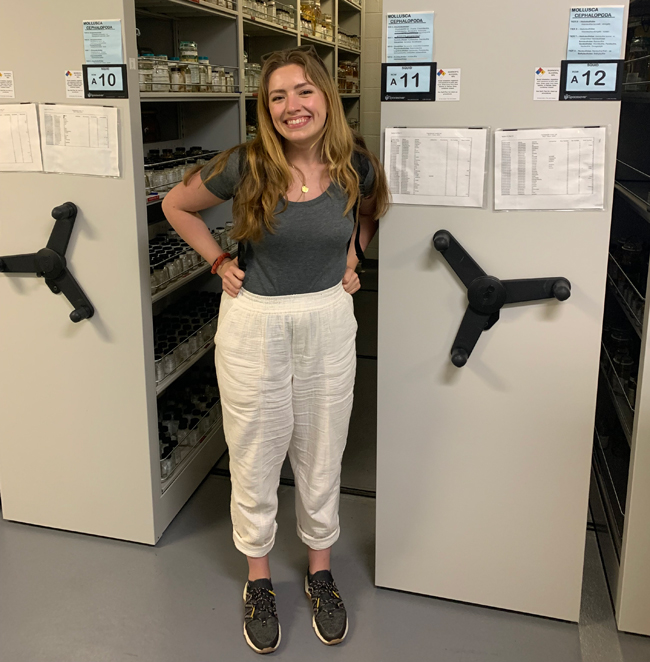
Mehlhorn enjoying a behind-the-scenes tour of the Smithsonian invertebrate collections at the Museum Conservation Institute. Credit: Anna Mehlhorn
Mehlhorn first learned about the Knauss Fellowship during an internship with the Smithsonian Environmental Research Center, where she had the opportunity to weave a variety of stakeholder perspectives into a research project on invasive fish ecology. Mehlhorn sees the fellowship as an opportunity to take a multifaceted approach to federal policy, especially as it relates to her interests in estuarine ecosystems, field education, and deep-sea mining. As an interdisciplinary researcher who combines her love for science with a passion for art, Mehlhorn enjoys using innovative methods to engage community members.
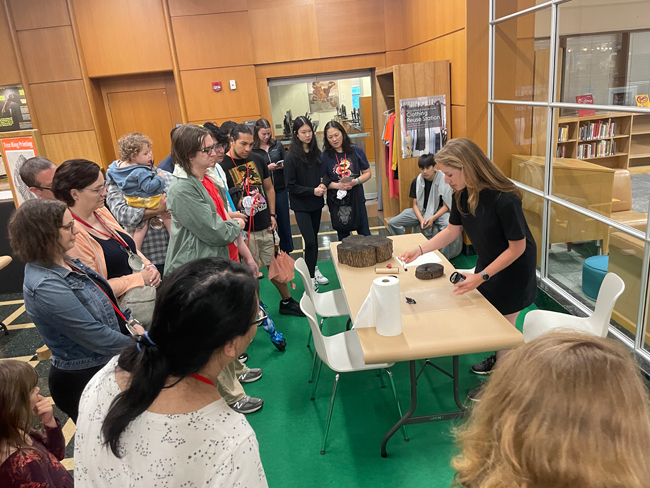
Mehlhorn leads a workshop at Cornell University, teaching attendees about the risks of invasive insects and other threats to Northeastern forests through the art of printmaking. Credit: Anna Mehlhorn
“I have always enjoyed bringing people with different ways of viewing the world into conversation, especially as someone working at the intersection of art and science,” Mehlhorn says. “As a Knauss Fellow, I hope to build on this interest by connecting [with] scientists, legislators, organizations, and others at the forefront of marine conservation.”
Brianna Lounsbury
SUNY College of Environmental Science and Forestry
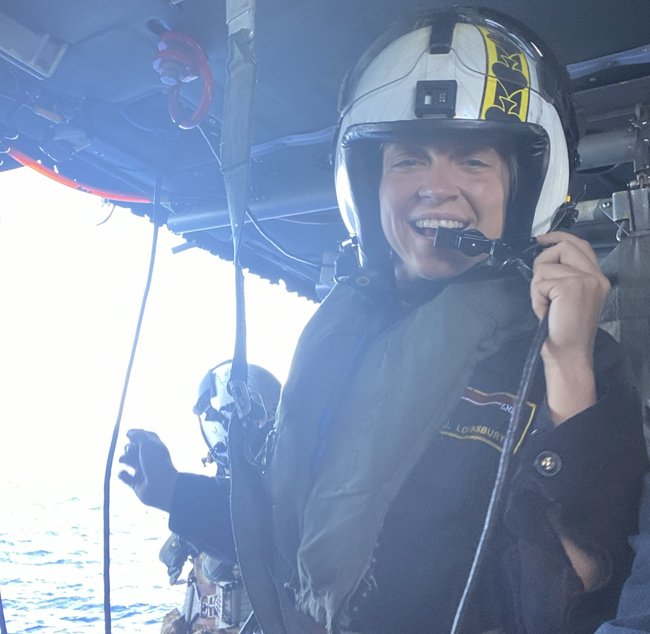
Lounsbury in a MH-60S while underway on the USS Essex for Rim of the Pacific (RIMPAC) exercise 2020. As the assistant METOC Officer onboard, Lounsbury and a few sailors from her team got the opportunity to drop buoys for NOAAs Global Drifter program. Credit: Brianna Lounsbury
U.S. Navy Officer, LT Brianna Lounsbury knew that she wanted to work in policy at the end of her undergraduate degree. Now, the Knauss Fellowship is giving her a head start. When student loans felt overwhelming, she chose to drop out of graduate school to pursue joining the Navy as a Meteorology and Oceanography Officer, which she describes as “a heartbreaking but exciting time” in her life. Now in the reserves and back to working on her graduate degree, she hopes that the fellowship will be the perfect next step to a career in policy.
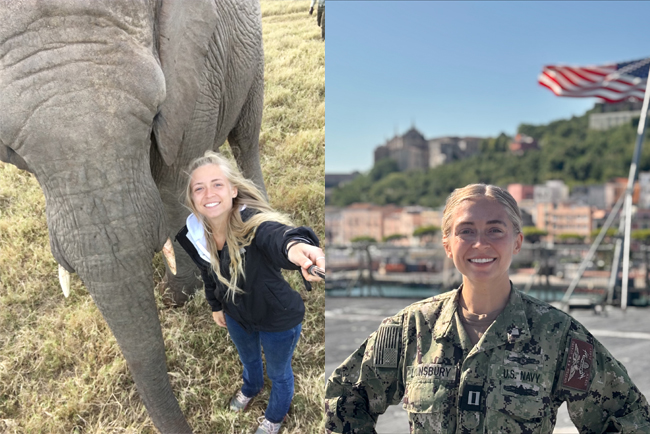
(At left) Lounsbury poses with an elephant taken during her first trip to South Africa in 2016, where she worked at a wildlife reserve for a month. Kwangju Wildlife Reserve had an elephant sanctuary she would visit every week. (At right) A headshot of Lounsbury taken while onboard USS Mount Whitney in Gaeta, Italy. Lounsbury is the SIXTHFLT Oceanographer and has been stationed in Naples, Italy since 2022. She is transitioning from active duty to reserve. Credit: Brianna Lounsbury
As a Knauss Fellow, Lounsbury plans to find out more about how policies are made, passed, and implemented. She has a particular interest in wildlife trade policy in relation to conservation, as well as how federal agencies like NOAA collaborate with the U.S. Coast Guard and the U.S. Navy. She is also curious to know more about international marine policy, a topic that supports her master’s thesis on shark fishing in the Mediterranean.
“Being selected as a fellow is the perfect opportunity for getting my foot in the door working a career in conservation, especially in developing greater understanding in how particular policies get created, passed, and implemented,” Lounsbury explained. “Applying my military experience to conservation policy is a great way for me to expand my skills in a career field I’ve been wanting to work for my whole life.”
More Info: New York Sea Grant
Established in 1966, the National Oceanic and Atmospheric Administration (NOAA)’s National Sea Grant College Program promotes the informed stewardship of coastal resources in 34 joint federal/state university-based programs in every U.S. coastal state (marine and Great Lakes) and Puerto Rico. The Sea Grant model has also inspired similar projects in the Pacific region, Korea and Indonesia.
Since 1971, New York Sea Grant (NYSG) has represented a statewide network of integrated research, education and extension services promoting coastal community economic vitality, environmental sustainability and citizen awareness and understanding about the State’s marine and Great Lakes resources.
NYSG historically leverages on average a 5.5-fold return on each invested federal dollar, annually. We benefit from this, as these resources are invested in Sea Grant staff and their work in communities right here in New York.
Through NYSG’s efforts, the combined talents of university scientists and extension specialists help develop and transfer science-based information to many coastal user groups—businesses and industries, federal, state and local government decision-makers and agency managers, educators, the media and the interested public.
New York Sea Grant, one of the largest of the state Sea Grant programs, is a cooperative program of the State University of New York (SUNY) and Cornell University. The program maintains Great Lakes offices at Cornell University, SUNY Buffalo, Rochester Institute of Technology, SUNY Oswego, the Wayne County Cooperative Extension office in Newark, and in Watertown. In the State's marine waters, NYSG has offices at Stony Brook University and with Cornell Cooperative Extension of Nassau County on Long Island, in Queens, at Brooklyn College, with Cornell Cooperative Extension in NYC, in Bronx, with Cornell Cooperative Extension of Ulster County in Kingston, and with Cornell Cooperative Extension of Westchester County in Elmsford.
For updates on Sea Grant activities: www.nyseagrant.org, follow us on social media (Facebook, Twitter/X, Instagram, Bluesky, LinkedIn, and YouTube). NYSG offers a free e-list sign up via www.nyseagrant.org/nycoastlines for its flagship publication, NY Coastlines/Currents, which it publishes 2-3 times a year.