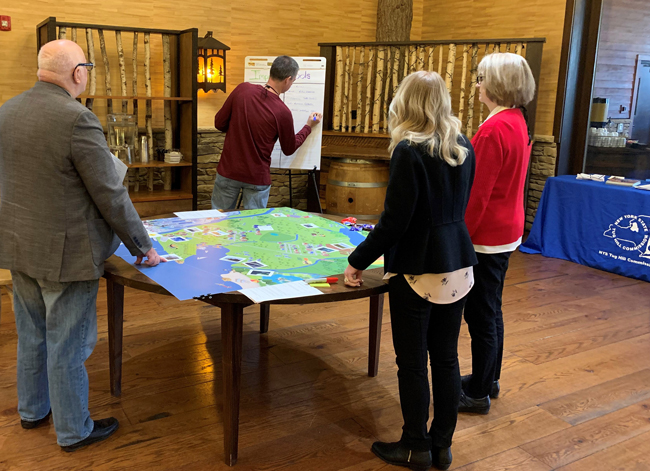
Collective thinking about how potential scenarios may impact the local community is an interactive way to keep planning initiatives off-the-shelf and active. Credit: Mary Austerman/New York Sea Grant
From Planning to Action: Municipal Training Series for New York's Great Lakes-St. Lawrence River Shoreline Communities
Hear from NY Sea Grant Coastal Processes Specialists, Tips for Success from Local Community Leaders
Contacts:
Mary Austerman, NYSG Great Lakes Coastal Community Specialist, E: mp357@cornell.edu, P: 315-312-3042
Lauren Darcy, New York Sea Grant Coastal Resiliency Specialist, E: led222@cornell.edu, P: 315-849-3962
Kara Lynn Dunn, NY Sea Grant Great Lakes Publicist, E: karalynn@gisco.net, P: 315-465-7578
Newark and Watertown, NY, April 14, 2026 - New York Sea Grant has announced educational opportunities for municipal leaders involved with land use management planning and implementation along New York's Great Lakes and St. Lawrence River. A two-part Coastal Community Development webinar series will feature information on coastal processes that impact the shorelines along Lake Erie, the Niagara River, Lake Ontario, and St. Lawrence River. Participants will learn how to successfully move from community planning to action and results. The webinars are free; to register, use the link below or call 315-342-3042 for more information.
Supervisors, mayors, code enforcement and building inspectors, planners, board members, and anyone involved with local land use and planning are invited to participate in these webinars.
• May 26, 2026, 1-2 pm: "Great Lake Coastal Processes for Municipal Leaders in NY" — New York Sea Grant Coastal Processes and Hazards Specialist Roy Widrig will provide information on how shorelines respond to the natural, dynamic and changing action of the waters along New York's Great Lakes and St. Lawrence River shorelines. — Register
• On June 9, 2026, 1-2 pm: "Keeping Your Plan Off the Shelf" — a panel of local government representatives who have successfully developed and implemented land use planning goals will share tips for keeping an active process moving after completing a local plan to accomplish the desired objectives and benefits for the local community. — Register
New York Sea Grant Coastal Community Development Specialist Mary Austerman said, "It is critical for those at the forefront of land use decision making and implementation to understand the coastal processes that impact the land in their area, as well as New York State regulatory and permitting requirements."
New York Sea Grant Coastal Resiliency Specialist Lauren Darcy works with communities along the eastern shore of Lake Ontario and the St. Lawrence River. Darcy said, "A lot of visioning and work go into comprehensive, open space, climate smart, and local waterfront revitalization planning, this webinar series is designed to keep that momentum going to ensure that the planning goals come to fruition."
New York Sea Grant provides this assistance with support from the New York State Environmental Protection Fund, in partnership with the New York State Department of Environmental Conservation's Great Lakes Program.
More Info: New York Sea Grant
New York Sea Grant (NYSG) is a university-based, statewide Federal-State collaboration between the State University of New York (SUNY), Cornell University, and the National Oceanic and Atmospheric Administration (NOAA). It is one of 34 university-based programs that connects research, extension, and education with the needs of coastal communities, environments, and economies through NOAA.
Since 1971, NYSG has supported science-based solutions for a wide range of water-related challenges and opportunities across the state. Through NYSG’s efforts, university scientists and extension specialists help develop and transfer science and technical information to educational institutions, businesses, agencies, and industries; federal, state and local governments; the media; and the interested public. The program is administratively based at Stony Brook University (SBU) and Cornell's College of Agriculture and Life Sciences (CALS).
NYSG historically leverages on average a 5.5-fold return on each invested federal dollar, annually. The State benefits from this, as these resources are invested in Sea Grant staff and their work in communities right here in New York.
New York Sea Grant, one of the largest of the state Sea Grant programs, maintains Great Lakes offices at Cornell University, SUNY Buffalo, Rochester Institute of Technology, SUNY Oswego, the Wayne County Cooperative Extension office in Newark, and in Watertown. In the State's marine waters, NYSG has offices at Stony Brook University and with Cornell Cooperative Extension of Nassau County on Long Island, in Queens, at Brooklyn College, with Cornell Cooperative Extension in NYC, in Bronx, with Cornell Cooperative Extension of Ulster County in Kingston, and with Cornell Cooperative Extension of Westchester County in Elmsford.
Established in 1966, the National Oceanic and Atmospheric Administration (NOAA)’s National Sea Grant College Program promotes the informed stewardship of coastal resources in 34 joint federal/state university-based programs in every U.S. coastal state (marine and Great Lakes) and Puerto Rico. The Sea Grant model has also inspired similar projects in the Pacific region, Korea and Indonesia.
For updates on Sea Grant activities: www.nyseagrant.org, follow us on social media (Facebook, Twitter/X, Instagram, Bluesky, LinkedIn, and YouTube). NYSG offers a free e-list sign up via www.nyseagrant.org/nycoastlines for its flagship publication, NY Coastlines/Currents, which it publishes quarterly.