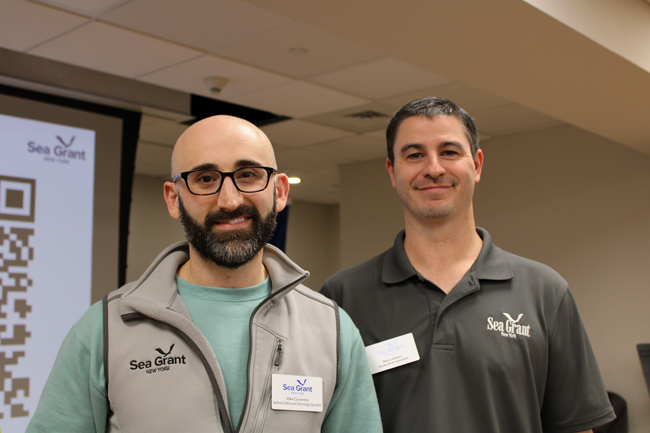
Left to right: Michael Ciaramella (Seafood Safety and Technology Specialist, New York Sea Grant) and Barry Udelson (Aquaculture Specialist, New York Sea Grant). Both Ciaramella and Udelson were coordinators for the downstate Seafood Summit and were part of the Summit planning team. Credit: Sumayyah Uddin/NYSG.
Contact:
Michael Ciaramella, Ph.D., NYSG Seafood Safety and Technology Specialist, E: mc2544@cornell.edu, P: 631-824-4746
Barry Udelson, NYSG Aquaculture Specialist, E: bu25@cornell.edu, P: (631) 824-4934
Alongside partners, government agencies, and aquaculture industry guests, NYSG specialists Mike Ciaramella (Seafood Safety and Technology Specialist) and Barry Udelson (Aquaculture Specialist) helped coordinate another successful year of the Riverhead Seafood Summit.
— By Sumayyah Uddin, NYSG's Science Writer
Riverhead, NY, March 27, 2026 — For a decade, the New York Seafood Summit has brought together industry experts, government officials, and aquaculture workers for regional agency and association updates, industry highlights, and resources for seafood-related issues and concerns. It has expanded from a small meeting in Manhattan to three events (upstate, mid-state, and downstate) that address pressing issues in each area of the state.
The hybrid downstate event, held in Riverhead Free Library in Riverhead, NY, helped to facilitate discussions on important topics in the seafood industry, from the fuel tax that impacts New York fishermen to a Working Waterfronts panel, which addressed pressing concerns for Long Island’s coastal workforce.
“This [is] a great way to foster collaboration, learning from one another, and — for us at Sea Grant — to get a better sense of what the needs were and how we could work to support the industry and the consumers,” said Michael Ciaramella, a NYSG Seafood Safety and Technology Specialist and one of the founders of the Seafood Summit, as he introduced the event.
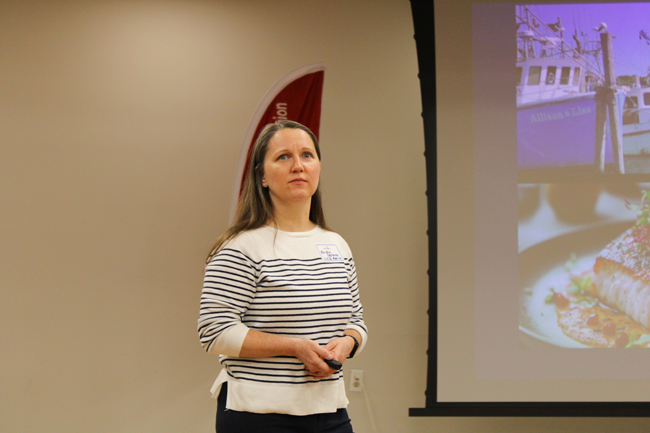
Kristin Gerbino (Fisheries Specialist, Cornell Cooperative Extension) presented on the Long Island Seafood Trail. The Seafood Trail, which launched in 2025, shows restaurants and markets that serve locally caught and produced Long Island seafood. “Right now, the Seafood Cuisine Trail runs seventy-five miles from Bay Shore to Montauk. There are twenty restaurants and fish markets that have an elevated commitment to local seafood. The application for the North Trail has just been approved. So we're really excited that there will be a secondary trail on the North Shore that goes from Greenport to Northport.” Credit: Sumayyah Uddin/NYSG.
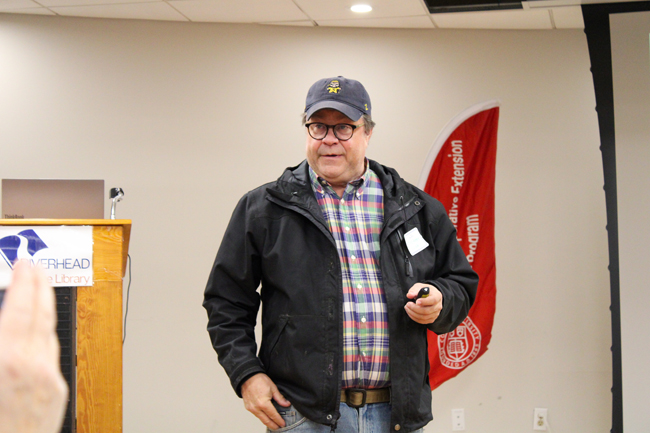
Eric Koepele (President, Long Island Oyster Growers Association). Koepele presented on the impacts of the extreme cold weather that affected Long Island in early 2026 — and the steps LIOGA and others took to mitigate them. “?In summary, I'd say we are getting past all the winter stuff, and we're looking forward to another season out on the water with some new brands and some farms that are starting to scale in a nice way.” Credit: Sumayyah Uddin/NYSG.
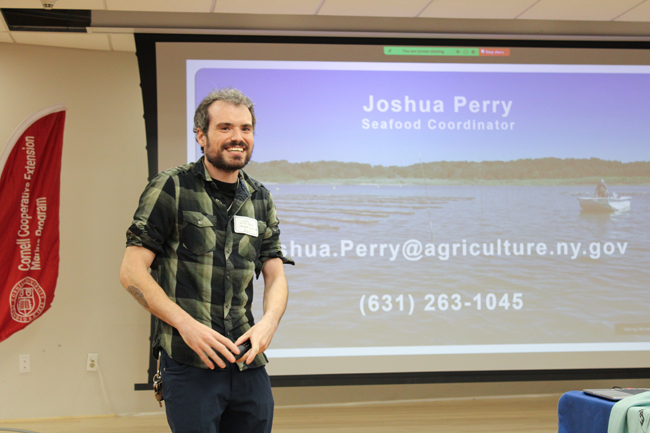
Joshua Perry (Seafood Coordinator, Department of Agriculture and Markets) presented updates on various programs, including the Seafood Cuisine Trail, the Long Island Seafood Processing Feasibility Study, and upcoming grant opportunities. Credit: Sumayyah Uddin/NYSG.
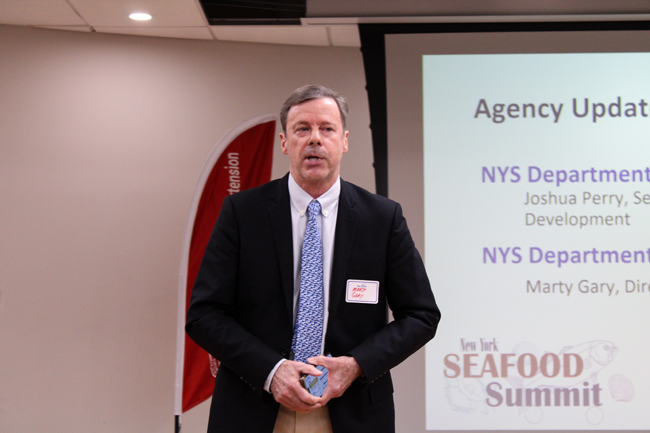
Marty Gary (Director, Division of Marine Fisheries, New York State Department of Environmental Conservation). Gary provided agency updates from the DEC on how they conserve environmental spaces while taking into account factors like economic impact. “Our mission at New York DEC, Division of Marine Resources, is to conserve, protect, and improve the marine resources and habitats in the New York Marine District.” Credit: Sumayyah Uddin/NYSG.
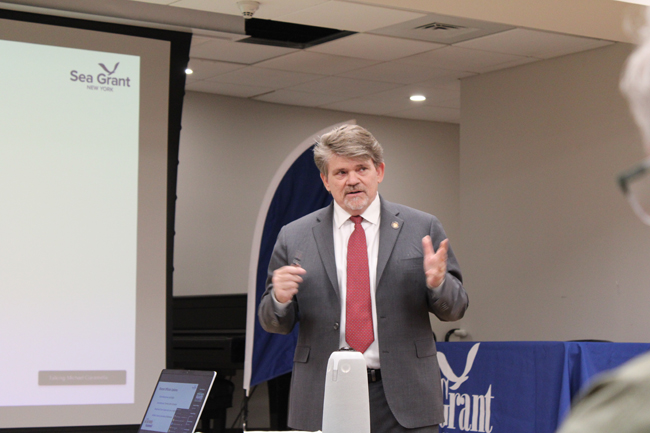
Tommy John Schiavoni (NYS Assemblyman) assured attendees that as their assemblyman, he was doing his best to represent them on key issues — including aquaculture. “?I love my district. Did you know that we have the powerhouse of estuary food production in Suffolk County in the Peconic Bay? I'm proud to represent the area.” Credit: Sumayyah Uddin/NYSG.
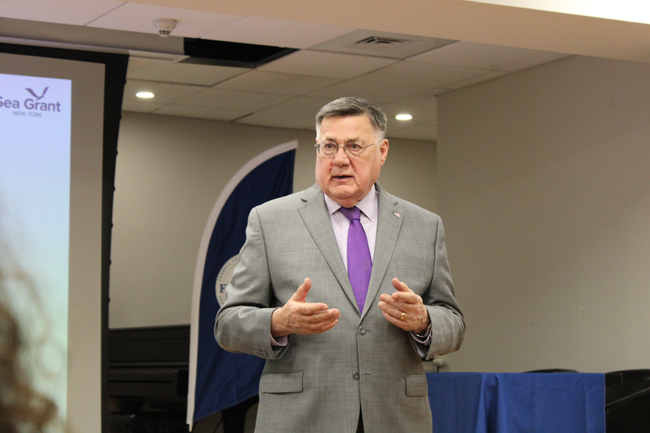
Ed Romaine (Suffolk County Executive) emphasized the importance of removing the New York fuel tax, which makes it difficult for local fishermen. "If you want to help people in Suffolk, particularly for fishermen, for those who make their living on the water, relieve the fuel tax.” Credit: Sumayyah Uddin/NYSG.
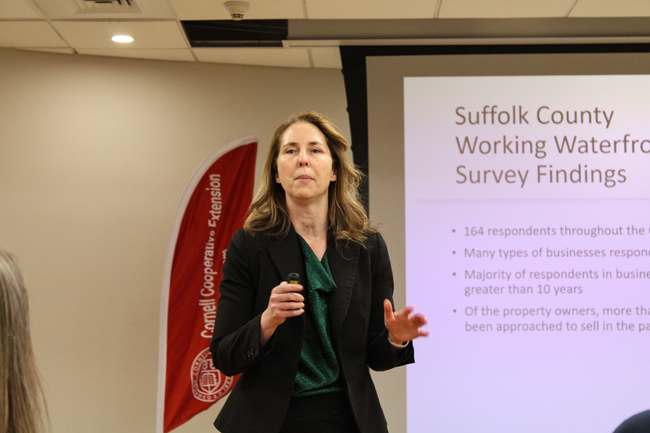
Sarah Lansdale (Commissioner, Suffolk County Department of Economic Development and Planning) went over the results of the Working Waterfronts Survey. The survey was done through the Working Waterfronts Program, which “?creates a mechanism for the voluntary preservation of the property” while property owners retain full ownership. Credit: Sumayyah Uddin/NYSG.
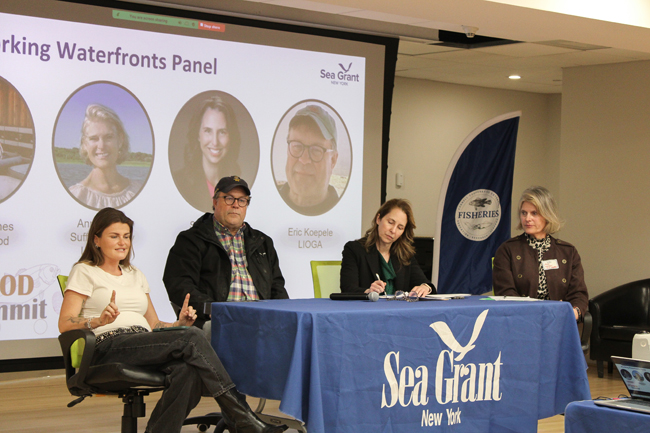
Left to right: Amanda Jones (Director of Operations, Inlet Seafood), Eric Koepele (President, Long Island Oyster Growers Association), Sarah Lansdale (Commissioner, Suffolk County Department of Economic Development and Planning), and Ann Welker (Suffolk County Legislature) on the Working Waterfronts Panel. The group took the time to discuss and answer questions about pressing concerns affecting people who work in and around waterfronts. Credit: Sumayyah Uddin/NYSG.
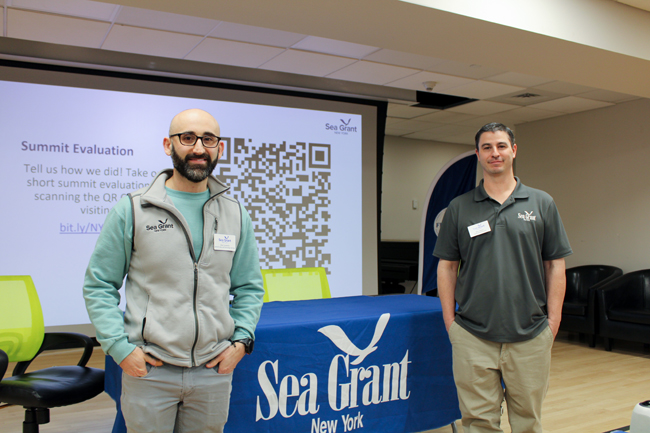
Left to right: Michael Ciaramella (Seafood Safety and Technology Specialist, New York Sea Grant) and Barry Udelson (Aquaculture Specialist, New York Sea Grant). According to Ciaramella, the Seafood Summit originally started as a smaller event in 2016. “It was just a small group of folks meeting in Manhattan. We tried to get various representation from the different sectors of the New York seafood industry to facilitate conversations and discussions around the challenges of the industry and the need to focus more on opportunities.” Credit: Sumayyah Uddin/NYSG.
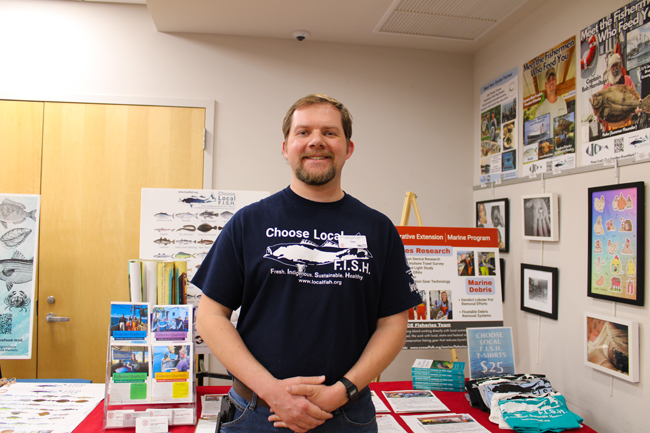
Tyler Guteres (Fisheries Technician, Marine Program, Cornell Cooperative Extension Suffolk County) tabled at the event. He especially appreciated the discussion of the barriers to commercial fishing. “It's very hard, especially for younger folks, to get into commercial fishing unless they're directly next of kin — and even then it's really kind of less than a 50-50 shot, honestly. The more we can do to reduce those barriers, the better.” Credit: Sumayyah Uddin/NYSG.
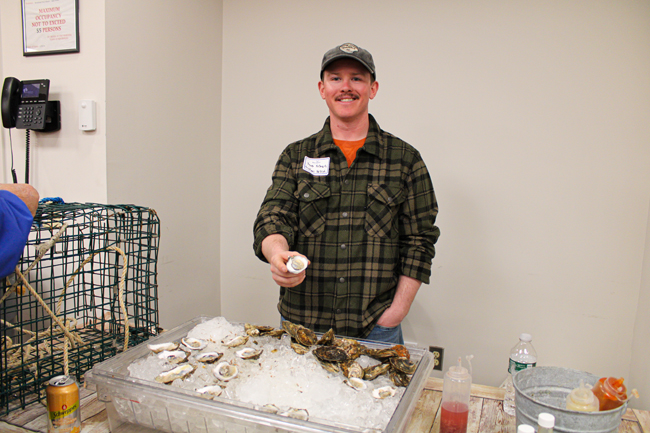
Jacob Feibusch (Owner, Davy Jones Shellfish Co.) poses with his wares: fresh oysters and various sauces. A local Long Island oyster seller and the founder of Davy Jones Shellfish Co. — which describes its merchandise on its website as “Always fresh, always local, sustainable, wild-caught and farm-raised” — Feibusch brought, prepped, and served fresh oysters to event attendees. Credit: Sumayyah Uddin/NYSG.
More Info: New York Sea Grant
New York Sea Grant (NYSG) is a university-based, statewide Federal-State collaboration between the State University of New York (SUNY), Cornell University, and the National Oceanic and Atmospheric Administration (NOAA). It is one of 34 university-based programs that connects research, extension, and education with the needs of coastal communities, environments, and economies through NOAA.
Since 1971, NYSG has supported science-based solutions for a wide range of water-related challenges and opportunities across the state. Through NYSG’s efforts, university scientists and extension specialists help develop and transfer science and technical information to educational institutions, businesses, agencies, and industries; federal, state and local governments; the media; and the interested public. The program is administratively based at Stony Brook University (SBU) and Cornell's College of Agriculture and Life Sciences (CALS).
NYSG historically leverages on average a 5.5-fold return on each invested federal dollar, annually. The State benefits from this, as these resources are invested in Sea Grant staff and their work in communities right here in New York.
New York Sea Grant, one of the largest of the state Sea Grant programs, maintains Great Lakes offices at Cornell University, SUNY Buffalo, Rochester Institute of Technology, SUNY Oswego, the Wayne County Cooperative Extension office in Newark, and in Watertown. In the State's marine waters, NYSG has offices at Stony Brook University and with Cornell Cooperative Extension of Nassau County on Long Island, in Queens, at Brooklyn College, with Cornell Cooperative Extension in NYC, in Bronx, with Cornell Cooperative Extension of Ulster County in Kingston, and with Cornell Cooperative Extension of Westchester County in Elmsford.
Established in 1966, the National Oceanic and Atmospheric Administration (NOAA)’s National Sea Grant College Program promotes the informed stewardship of coastal resources in 34 joint federal/state university-based programs in every U.S. coastal state (marine and Great Lakes) and Puerto Rico. The Sea Grant model has also inspired similar projects in the Pacific region, Korea and Indonesia.
For updates on Sea Grant activities: www.nyseagrant.org, follow us on social media (Facebook, Twitter/X, Instagram, Bluesky, LinkedIn, and YouTube). NYSG offers a free e-list sign up via www.nyseagrant.org/nycoastlines for its flagship publication, NY Coastlines/Currents, which it publishes quarterly.