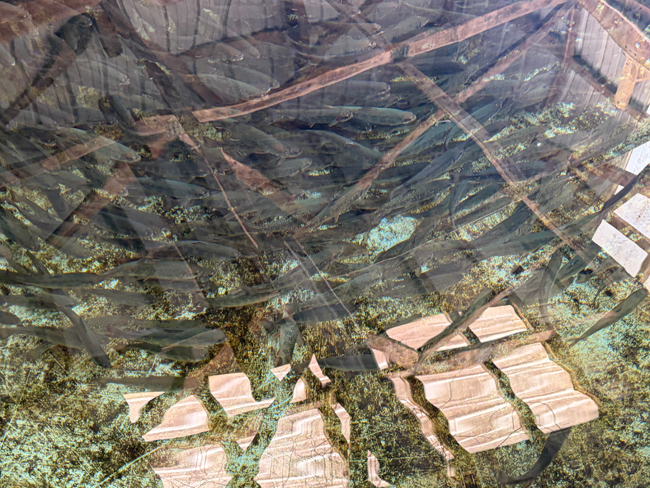
Credit: Barry Udelson
Over the summer, NYSG collaborated with MISG and SUNY Morrisville to conduct a two-day introductory aquaponics workshop for NYS educators.
— By Sumayyah Uddin, NYSG's Science Writer
Contact:
Barry Udelson, NYSG Aquaculture Specialist, E: bu25@cornell.edu, P: (631) 824-4934
Stony Brook, NY, September 16, 2026 - In collaboration with Michigan Sea Grant (MISG) and SUNY Morrisville, New York Sea Grant hosted a one and a half day workshop for educators interested in aquaculture and aquaponics. The goal was not only to teach educators about aquaculture and aquaponics through presentations, labs, and other activities, but to prepare them to teach it to their students in a train-the-trainer type of model. Open to any science or agriculture teacher in New York State, the workshop was based on MISG’s pre-existing workshop series that became part of the Great Lakes Aquaculture Collective (GLAC) objectives to expand aquaculture education.
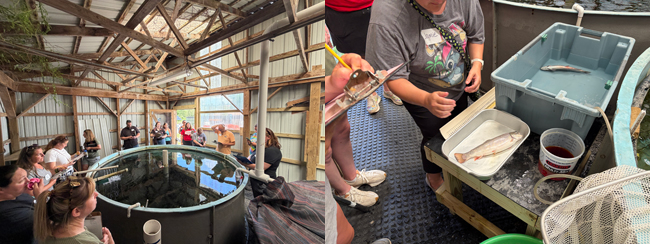
(L) Workshop attendees gather around one of the tanks at SUNY Morrisville’s Aquaculture Center used for raising various species of fish. (R) After anesthetizing the trout, length and weight measurements were taken by participants as part of the fish handling activity. Credit: Barry Udelson
“This workshop is quite a valuable opportunity for New York because there are minimal, if any, opportunities for them to bring aquaculture into the classroom. It is quite common for field trips to occur where students can see traditional agriculture farms but that isn’t the case for the aquaculture sector,” explained Barry Udelson (NYSG, Aquaculture Specialist), the workshop’s NYSG facilitator.
“Part of that is because there aren’t as many operations around, as this field is still growing,” he continued. “This workshop provides teachers with resources to bring aquaculture into the classroom and also educates teachers that may not be aware of how much aquaculture exists in New York. I’m excited to be connected with teachers because I can provide them with resources, connect them with aquaculture farmers, or develop new ideas with them to help increase awareness about aquaculture and how important it is for the production of food.”
The Teacher Aquaponic Workshop, which took place in July, featured a mix of hands-on and lecture-based activities. Participating teachers had the opportunity to participate in a water quality lab, handle fish, take fish measurements, and engage with other hands-on activities that provided both a well-rounded learning experience and inspiration for how they could create an aquaculture experience for their students.
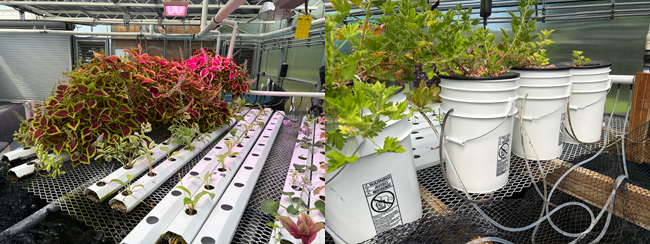
The greenhouse at SUNY Morrisville’s Aquaculture Center utilizes different methods for raising plants aquaponically. On the left are various plants using the Nutrient Film Technique (NFT) and on the right are Dutch buckets. Both systems use water from the tank below, where paddlefish are being raised. Credit: Barry Udelson
Attendees were given a travel stipend, earned 13 CTLE (education contact) hours, and received a certificate as part of the workshop. At the end of the workshop, participants received a 10-gallon aquarium tank with all the necessary components to take back to their classrooms so that they could set up a small aquaponics system; a material list and ideas of how to get their students started; and a Google Drive folder so that they could have access to what they had learned.
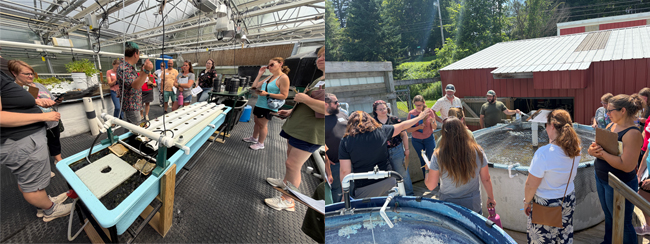
Teachers were given a tour of SUNY Morrisville’s Aquaculture Center, where various species of fish are raised for research, education, and stocking purposes. The tour included explanations of how the various systems worked, how water moves around the facility, and what type of maintenance is required. On the left is one of the aquaponic systems in the greenhouse and on the right are some of the tanks for the trout being raised. Credit: Barry Udelson
Udelson explained that what was provided through the program was just a foundation — it will ultimately be up to the teachers to take what the workshop gave them, adapt it to their classrooms and schools, and decide what to do with it.
“My hope is that we provided the teachers with enough tools and information that they will be able to bring aquaculture, in any form, into their classroom and expose their students to this field,” Udelson said, reflecting on the program. “It would be great if teachers could have their students build a system and maintain it throughout the school year, but not everyone has the capacity for that. It can be a display and educational system for teachers to reference while utilizing some of the curriculum or activities we shared. Teachers are very creative and they will find ways within their capacity to incorporate aquaculture into their classes, which will exponentially expand Sea Grant’s efforts to educate future generations about aquaculture.”
The event would not have happened without help and collaboration from other Sea Grant programs. Elliot Nelson (MISG, Extension Specialist) has been working for months on expanding this workshop beyond Michigan into other Great Lake states through the Sea Grant GLAC Hub. The educators were not the only ones engaging in a train-the-trainer model; this workshop was also a chance for Nelson to directly train Udelson in planning a successful, long-term program as a fellow extension specialist.
While planning the New York event, both Udelson and Nelson were challenged by the fact that while it would be ideal to have this workshop somewhere with an aquaculture operation, there weren’t too many options to choose from. Luckily, Elisa Livengood (Associate Professor at SUNY Morrisville) had the perfect opportunity: she runs the college’s Aquaculture Center, which ultimately served as home base for the workshop. Livengood has dreamed of realizing a program like this since she was a post-doc.
“The best part of conducting the summer workshop was definitely realizing this dream of mine for the last 10 years,” Livengood said. “I began working with teachers when I was a PhD student at the University of Florida. We created an aquaculture curriculum for teachers with support from a team of educators across University of Florida faculty called Teach Aquaculture; since then, I had been dreaming of doing a similar and more expansive curriculum to serve teachers across the state of New York.”
While Livengood has fostered other similar programs while continuing to pursue funding, such as the Trout Spawning Seminars, they were limited by location and timing. She describes the success of the Aquaponics Workshop as a “full-circle” moment.
“Aquaculture remains a powerful teaching tool and can be a ‘hook’ to engage students’ interest in agriculture and science,” she explained. “With [both] Michigan and New York Sea Grant’s support, we were able to develop this Aquaponics Workshop to serve teachers across the state of New York and give them both the knowledge and skills to implement aquaculture as a teaching tool in their schools.”
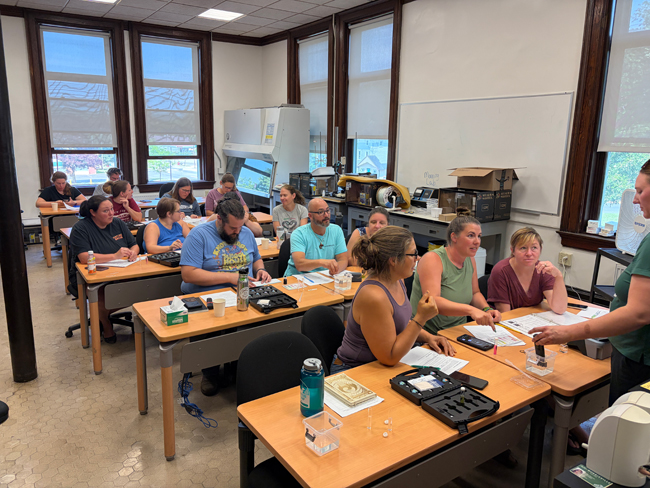
Workshop attendees participating in the water quality lab activity, which is part of the curriculum that was shared with them post-workshop. Credit: Barry Udelson
So, what’s next for the Teacher Aquaponics Workshop? Nelson has been training Udelson on the structure and tools needed to be able to offer the program again next year. The ultimate goal is for NYSG to have an annual workshop that continues to develop over time, growing exponentially through the train-the-trainer model as teachers pass on information to more and more students during the school year. Udelson also plans to try to set up a workshop closer to his Long Island home base — such as at Flax Pond in Stony Brook — so that it is easier for Long Island and NYC teachers to have a chance to participate locally.
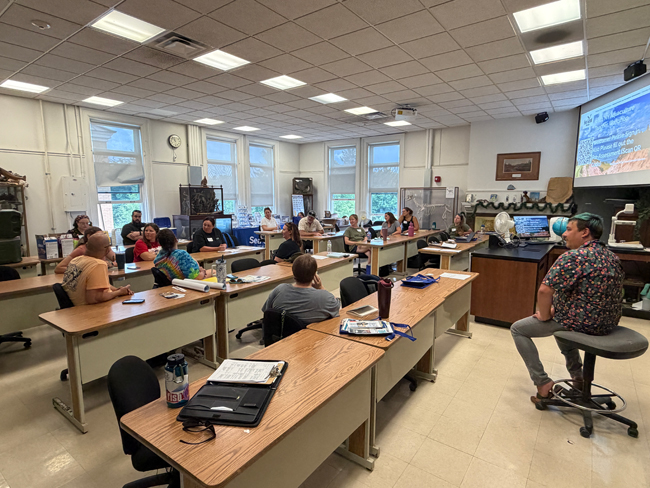
There were multiple lecture topics presented at the workshop to educate the teachers, one of which is pictured above. Lectures were designed for discussion, allowing participants to ask questions and share ways to bring these topics to their classrooms. Credit: Barry Udelson
The educators who participated this year were overwhelmingly positive in their feedback of the program.
One participant pointed out all the helpful aspects they liked while attending the workshop: “Seeing the different set ups around the college and learning about how to manage and take care of a system, including safety measures, measuring fish, collecting data and how to manage emergencies.” Others were hopeful that this workshop would help them change the way they approached aquaponics in the classroom, from creating more opportunities for students to build their own setups to implementing systems into the classroom.
One of the attendees ultimately summed up everyone’s experience best: “[This was] one of the best workshops I have ever participated in.”
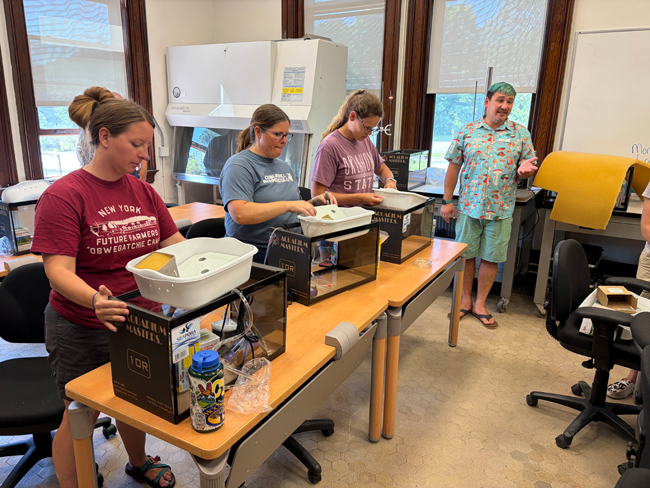
Workshop participants reviewing the aquaponic systems they received to bring back to the classroom. Credit: Barry Udelson
More Info: New York Sea Grant
New York Sea Grant (NYSG) is a university-based, statewide Federal-State collaboration between the State University of New York (SUNY), Cornell University, and the National Oceanic and Atmospheric Administration (NOAA). It is one of 34 university-based programs that connects research, extension, and education with the needs of coastal communities, environments, and economies through NOAA.
Since 1971, NYSG has supported science-based solutions for a wide range of water-related challenges and opportunities across the state. Through NYSG’s efforts, university scientists and extension specialists help develop and transfer science and technical information to educational institutions, businesses, agencies, and industries; federal, state and local governments; the media; and the interested public. The program is administratively based at Stony Brook University (SBU) and Cornell's College of Agriculture and Life Sciences (CALS).
NYSG historically leverages on average a 5.5-fold return on each invested federal dollar, annually. The State benefits from this, as these resources are invested in Sea Grant staff and their work in communities right here in New York.
New York Sea Grant, one of the largest of the state Sea Grant programs, maintains Great Lakes offices at Cornell University, SUNY Buffalo, Rochester Institute of Technology, SUNY Oswego, the Wayne County Cooperative Extension office in Newark, and in Watertown. In the State's marine waters, NYSG has offices at Stony Brook University and with Cornell Cooperative Extension of Nassau County on Long Island, in Queens, at Brooklyn College, with Cornell Cooperative Extension in NYC, in Bronx, with Cornell Cooperative Extension of Ulster County in Kingston, and with Cornell Cooperative Extension of Westchester County in Elmsford.
Established in 1966, the National Oceanic and Atmospheric Administration (NOAA)’s National Sea Grant College Program promotes the informed stewardship of coastal resources in 34 joint federal/state university-based programs in every U.S. coastal state (marine and Great Lakes) and Puerto Rico. The Sea Grant model has also inspired similar projects in the Pacific region, Korea and Indonesia.
For updates on Sea Grant activities: www.nyseagrant.org, follow us on social media (Facebook, Twitter/X, Instagram, Bluesky, LinkedIn, and YouTube). NYSG offers a free e-list sign up via www.nyseagrant.org/nycoastlines for its flagship publication, NY Coastlines/Currents, which it publishes quarterly.