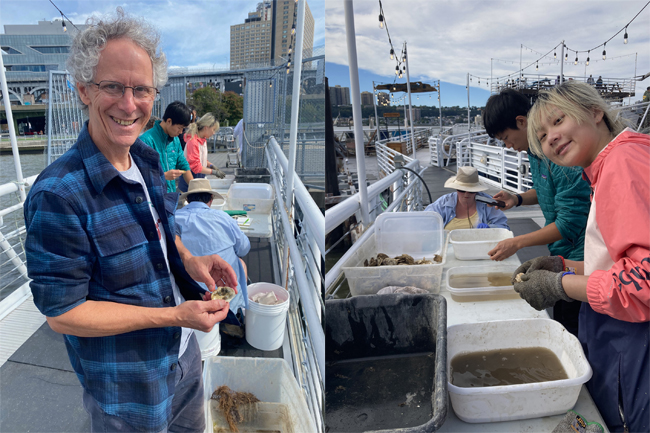
(at left) Matt Hare with Hare Lab members Harmony Borchardt-Wier, Hua, and Chen find spat (juvenile oysters) in shell bags that were deployed at the Baylander restaurant in West Harlem, NY. Credit: Scott Koen; (at right) Hare lab members Chen, Hua, and Borchardt-Wier scour shell from shell bags, looking for spat at the Baylander. Credit: Matt Hare
— By Chris Gonzales, Freelance Writer, New York Sea Grant
Contact:
Lane Smith, Research Program Coordinator, NYSG, E: lane.smith@stonybrook.edu, P: (631) 632-9780
Many people have taken an interest in restoring oysters to suitable habitat as a way of helping the environment. Local participants have been motivated, in part, by the history of thriving oysters in the New York City region.
New York, NY, June 4, 2024 - Oysters are sometimes referred to as ecosystem engineers because they build reefs that many other species use as habitat.
They also filter the water as they feed on microalgae, making it clearer. Clearer water lets more light reach eelgrass, which in turn bolsters the coastline, provides habitat for fish and birds, socks away carbon dioxide, and emits oxygen into the ocean.
As oysters filter the water, they store nutrients in their growing tissues and also deposit them as feces in bottom sediments, transferring organic compounds to the muddy bottom. This process improves the quality of coastal waters, which suffer from an excess of nutrients.
The restoration movement
Many have taken an interest in restoring oysters to suitable habitat as a way of helping the environment. These approaches have been of particular interest in fragile or distressed urban settings, such as New York City and Jamaica Bay, New York. In addition, local participants have been motivated, in part, by the history of thriving oysters in the region and are working to bring back an historical dimension to estuary vitality.
Dr. Matthew Hare, working on a project funded by New York Sea Grant, assembled an interdisciplinary team to study aspects of oyster biology that matter crucially for restoration. Hare is a molecular ecologist at Cornell University with expertise in marine biology and conservation genetics. Other team members included Sean Kramer, a mathematician and modeler at Norwich University; Matt Gray, an oyster biologist and ecophysiology expert at University of Maryland Center for Environmental Science; Damian Brady, a water quality and oceanography expert at University of Maine; and Ann Frioli, an outreach and education specialist with the Billion Oyster Project.
Hare’s team studies a type of native oyster called the eastern oyster, Crassostrea virginica. The oysters Hare plans to restore aren’t intended to be eaten—those oysters will come from farms in cleaner waters. Still, it’s the same species, ranging all along the eastern coasts of North and Central America.
Larvae on the go
When oysters reproduce, tiny larvae are created which swim and drift in the water for two to three weeks, sometimes dispersing for miles but not necessarily going where intuition would suggest. Hare and his team employed a model of Hudson Estuary hydrodynamics to determine which areas of habitat would be best for rapid oyster population growth and for maximum filtration services.
They used an existing hydrodynamic model that has been well-validated for accuracy for the Hudson River Estuary. In their simulations, synthetic larvae (referred to as “particles”) were “released” during the known breeding season and coded to swim as larvae typically do: vertically in patterns, as inferred from previous experiments.
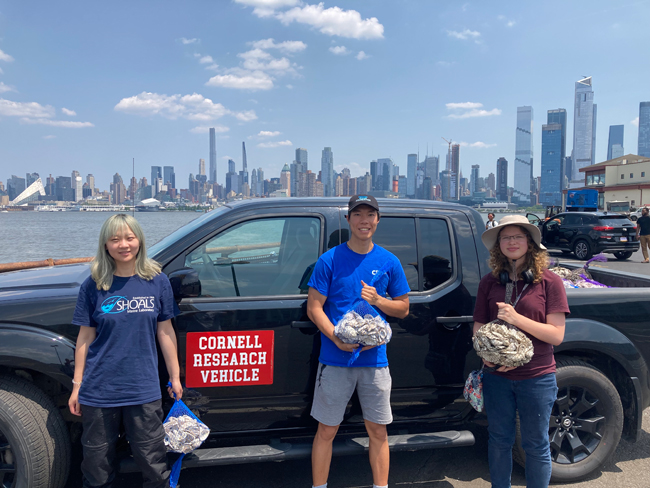
Hare lab members and volunteers (left to right) Yuqing Chen, Henry Hua, and Marusya Krasnikova hold mesh bags of shell provided by the Billion Oyster Project for Hare Lab research. These bags of shell are used as juvenile oyster collectors in the Hudson. Credit: Matt Hare
Sustainable reefs succeed together
Oysters, corals, and eelgrass are tied to bottom habitats. They inhabit patches that are sustainable only by migration among patches.
“Restore one reef and you have a potent community project,” Hare said. “Restore multiple strategically located reefs and you have the potential for a sustainable population.”
Unfortunately, predicting the dispersal paths and settlement endpoints of larvae in an estuary is very difficult. Estuaries lie at the intersection of rivers and ocean tides, creating a dynamic hydrological system. Larvae are too small to fight the tide. Typical estuarine stratification is generated by freshwater flowing downstream near the surface, and incoming salty tidal water wedging below the lighter freshwater. Larvae of different estuarine species have evolved vertical swimming strategies, relative to the stratification, that keep them from getting flushed out to unsuitable ocean habitat. Clearly, larval dispersal is an interaction between hydrodynamics and larval behavior.
At 21 days of age, the simulated larvae become physiologically capable of “settling” and swim toward the bottom of the river. This date marks the end of larval dispersal and the beginning of metamorphosis into sessile spat, the juvenile life stage after larvae attach to a hard substrate. The model records the endpoint location of every particle relative to its release location for comparison with spat abundance counts made by Hare. He has made these counts annually since 2018.
New larval settlement
Once the modeling was done, the researchers categorized the possible larval settlement patterns. Oysters might be recruited locally—settled on substrate in the vicinity of their parents. Another fraction might land in unsuitable habitat or get flushed out to sea and be considered dead. Intuition might suggest that most of the tiny particles will have a net downstream movement toward the ocean. However, all of the model runs produced by Hare focused on the Hudson River north of New York Harbor and mostly showed larvae moving north—upstream—from their release location.
Eighty percent of particles released from Hudson River Park in lower Manhattan settled on the western shore, and most of the east shore settlement was near the remnant Tappan Zee population north of the city. (This population of oysters has received quite a bit of scientific attention since their rediscovery by oyster mitigation work for the Tappan Zee bridge replacement.1)
Results from the model are consistent with five years of field data showing spat numbers are usually highest near the Tappan Zee remnant population and decrease rapidly to the south.
“That’s good news for natural reproduction supplementing the Tappan Zee population,” Hare said, “but not so helpful if we want larvae from Tappan Zee to help repopulate the lower estuary.”
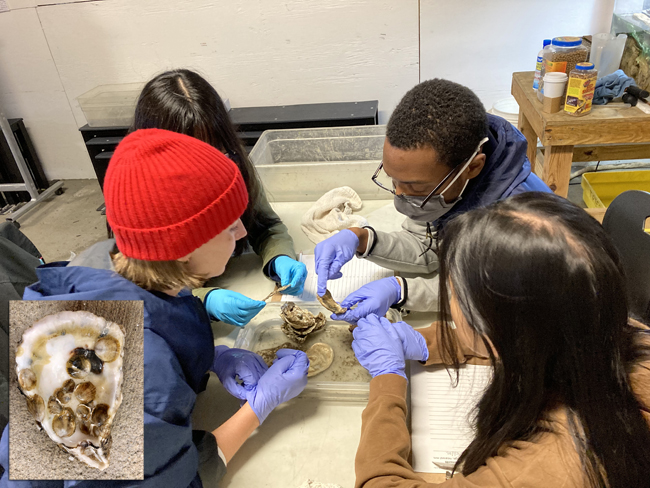
Four community scientists find spat among hundreds of shells gathered from shell bags deployed in Hudson River Park. This event, hosted by the River Project at pier 40, invited community scientists to take part in the most fun part of this research—finding spat among all the tunicates, bryozoans, crabs, and barnacles that foul the shell after a month’s deployment. The goal is to get an accurate count of spat and collect their tissues for genomic analysis. (Inset) Example of spat on shell. This photo shows the variety of colors and shapes among Hudson River wild juvenile oysters that are approximately 1-2 months old (1 – 1.5 cm in their longest dimension). Credit: Matt Hare
Biofiltration potential
Scientists are continuing their research with the model, seeking to more fully understand the forcing factors that make larvae scatter. They’re also working to more fully map the potential larval connectivity patterns that could be promoted among restoration sites if built in locations that optimize larval exchange.
Hare and his team’s work will help planners determine these optimal restoration locations. The choice of these sites will also be informed by analyses of where biofiltration can do the most good.
Packets of Organics
If we imagine river currents and tides moving algae and silt around, but with a net outflow into the ocean, any particular “packet” of water and its load of organic materials will be subject to oyster filtration only for a limited period of time. Scientists use the term “residence time” to indicate the length of time these units of water remain in a given area, making them subject to filtration. The research focus of the Hare team—modeling oyster restoration benefits—requires an understanding of residence time and how it interacts with oyster biomass.
Their modeling shows that water residence time in different parts of Hudson River Estuary varies from less than a day—where water rushes past these locations, giving oysters little opportunity to filter out organics—to 50 days in Jamaica Bay where tidal water enters and gets temporarily trapped.
Hare and his partners modeled several oyster restoration scenarios, all of them ambitious in terms of scope. However, Hare and his partners note, even a modest oyster restoration program could be good for Jamaica Bay. Restoring only 2-3 oysters per square meter, a level far below the oyster density achieved by some peer oyster restoration projects, could potentially filter 57% of Jamaica Bay water. In comparison, large-scale restoration in Chesapeake Bay has achieved oyster density goals of 50 oysters per square meter at many sites.
Other top candidates for oyster restoration sites based on filtration services potential are Newark/Kills and Lower Bay (Staten Island).
Restoring the oyster habitat is a complex enterprise where multiple goals must be pursued at once. It involves planning, funding, and building. The science contributed by Hare’s team advances our understanding of the ecological and population biology factors that are needed for integrative and strategic oyster habitat restoration.
Conclusion
As part of this project, the authors developed an interactive website to teach basic concepts related to oyster dispersal biology, estuarine nutrient cycling, oyster filter-feeding biology, and restoration planning.
The website can be found at: www.oysterecosystemmodels.com
More Info: About Eutrophication
Oxygen depletion is one of the most devastating impacts of what scientists call eutrophication, a condition when aquatic systems become overloaded with organic material and nutrients. Organics enter coastal waters at elevated levels from erosion in the watershed, by storm water runoff over paved urban surfaces, and sewage overflows. Organic material also accumulates as a result of phytoplankton getting overfertilized by nitrogen and phosphorous in wastewater plant effluent. Oxygen depletion results from the microbial banquet these conditions create. Overabundant bacteria feed on organics, literally exhausting the available oxygen and leaving none for other organisms.
To the extent that oyster filter feeding can pull this banquet out of the water column and into their tissues, or “pooped” into the mud, they can help mitigate eutrophication in coastal waters.
It stands to reason that a greater number of oysters will filter a larger quantity of water. But it also turns out that a given number of oysters can provide a greater benefit in some places more than others.
References
1 An Urban Estuary Ready for an Oyster Comeback. Retrieved March 19, 2024.
More Info: New York Sea Grant
Established in 1966, the National Oceanic and Atmospheric Administration (NOAA)’s National Sea Grant College Program promotes the informed stewardship of coastal resources in 34 joint federal/state university-based programs in every U.S. coastal state (marine and Great Lakes) and Puerto Rico. The Sea Grant model has also inspired similar projects in the Pacific region, Korea and Indonesia.
Since 1971, New York Sea Grant (NYSG) has represented a statewide network of integrated research, education and extension services promoting coastal community economic vitality, environmental sustainability and citizen awareness and understanding about the State’s marine and Great Lakes resources.
NYSG historically leverages on average a 3 to 6-fold return on each invested federal dollar, annually. We benefit from this, as these resources are invested in Sea Grant staff and their work in communities right here in New York.
Through NYSG’s efforts, the combined talents of university scientists and extension specialists help develop and transfer science-based information to many coastal user groups—businesses and industries, federal, state and local government decision-makers and agency managers, educators, the media and the interested public.
New York Sea Grant, one of the largest of the state Sea Grant programs, is a cooperative program of the State University of New York (SUNY) and Cornell University. The program maintains Great Lakes offices at Cornell University, SUNY Buffalo, Rochester Institute of Technology, SUNY Oswego, the Wayne County Cooperative Extension office in Newark, and in Watertown. In the State's marine waters, NYSG has offices at Stony Brook University and with Cornell Cooperative Extension of Nassau County on Long Island, in Queens, at Brooklyn College, with Cornell Cooperative Extension in NYC, in Bronx, with Cornell Cooperative Extension of Ulster County in Kingston, and with Cornell Cooperative Extension of Westchester County in Elmsford.
For updates on Sea Grant activities: www.nyseagrant.org, follow us on social media (Facebook, Twitter/X, Instagram, Bluesky, LinkedIn, and YouTube). NYSG offers a free e-list sign up via www.nyseagrant.org/nycoastlines for its flagship publication, NY Coastlines/Currents, which it publishes 2-3 times a year.