New York Sea Grant celebrates the 2025 fellows who have just completed their year-long John A. Knauss Fellowship experience. These five fellows grew both professionally and personally as they served in both the legislative and executive branches, and shared their progress with NYSG in their own words.
— By Sumayyah Uddin, NYSG's Science Writer
Stony Brook, NY, February 12, 2026 – By the end of last month, New York Sea Grant’s 2025 Knauss fellows — Alyson Lowell (Stony Brook University), Beryl Kahn (City University of New York), Patricia McKee (Pace University), Kahad Adamu (University at Buffalo), and Dawn Parry (Cornell University) — officially wrapped up their year-long fellowship experience.
With the 47th class of Knauss Fellowship finalists set to start on June 1st, we reached out to the 2025 fellows for updates, in their own words, on their year-long fellowship experiences.
In Their Own Words
Alyson Lowell
Legislative Fellow, Sea Grant’s John A. Knauss Marine Policy Fellowship
Office of Senator Lisa Murkowski of Alaska
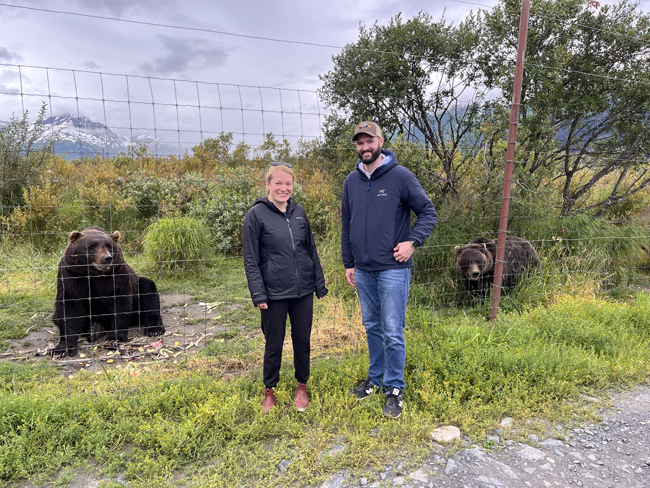
Alyson Lowell (left) and her mentor Matthew Robinson (right) pose in front of grizzly bears at the Alaska Wildlife Conservation Center. Credit: Alyson Lowell
I spent my Knauss year as a legislative fellow in the Office of U.S. Senator Lisa Murkowski (R-AK). As a fellow, I learned the intricacies of federal policy – from drafting bill text to negotiating bipartisan legislation. Most importantly, I learned the power of committed advocacy from the dedication of the Alaskan constituency. I most valued learning how to integrate needs across multiple user groups to support federal oceans and fishery policy initiatives, while simultaneously balancing real world constraints.
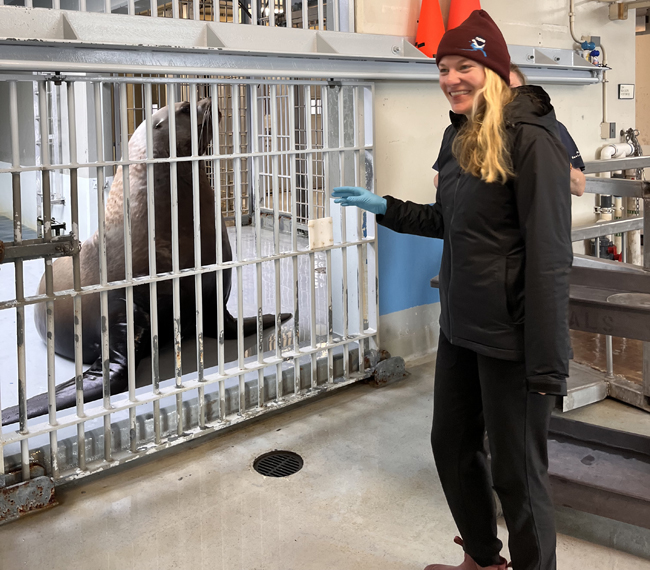
Lowell poses with a sea lion at the Alaska Sea Life Center. Credit: Alyson Lowell
Beryl Kahn
Executive Fellow, Sea Grant's John A. Knauss Marine Policy Fellowship
NOAA NOS National Centers for Coastal Ocean Science
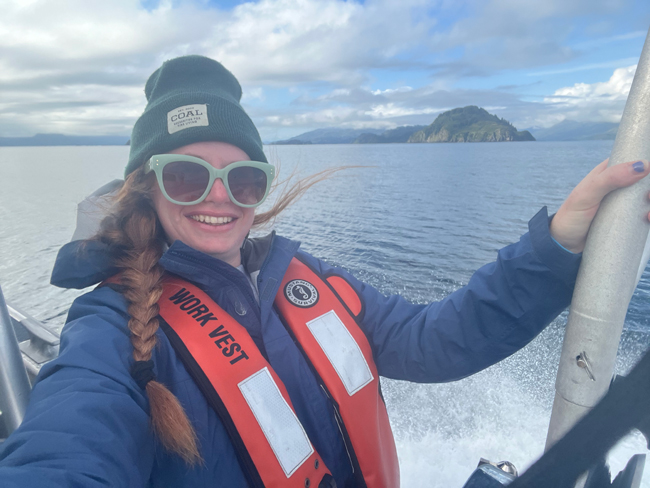
Beryl Kahn on a NOAA vessel in Chiniak Bay, Alaska. She and a group of NCCOS researchers collected samples of water to test for the harmful algae Alexandrium catella, which can cause paralytic shellfish poisoning. Credit: Beryl Kahn
The growth I gained over the course of my fellowship year, both personally and professionally, cannot be overstated. In my host office, the National Centers for Coastal Ocean Science (NCCOS), I had the unique opportunity to learn how applied coastal science benefits the nation, both in terms of how the office funds critical research on topics like harmful algal blooms (HABs) and coastal resilience, as well as communicates that vital work to the general public. I was fortunate to have extremely supportive mentors and wonderful colleagues in my host office, who took me under their wings to show me how to effectively translate the critical research the office funds into easily digestible communications pieces for the public, including research news items and fact sheets.
I got to travel to Kodiak, Alaska, to help sample for HABs, the data of which will be used to produce HAB growth models that can protect the public. I also visited some of NCCOS's laboratories in Kasitsna Bay, Alaska, and Oxford, Maryland, to learn more about how applied science helps local communities through research on shellfish safety and coastal forecasting. At a time when our coastal communities need the best available science in order to adapt to a shifting world, I really enjoyed getting to both learn and participate hands-on in an office that provides that service.
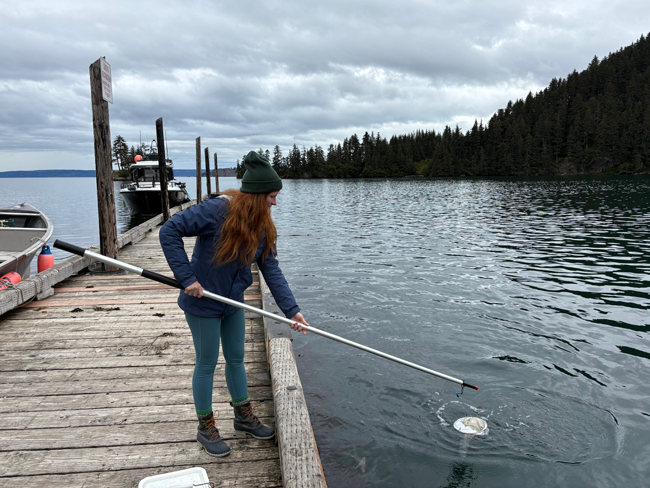
Kahn uses a plankton net to sample for harmful algae that is used in local HAB forecasting outside of the Kasitsna Bay Laboratory (located in Seldovia, Alaska). Credit: Beryl Kahn
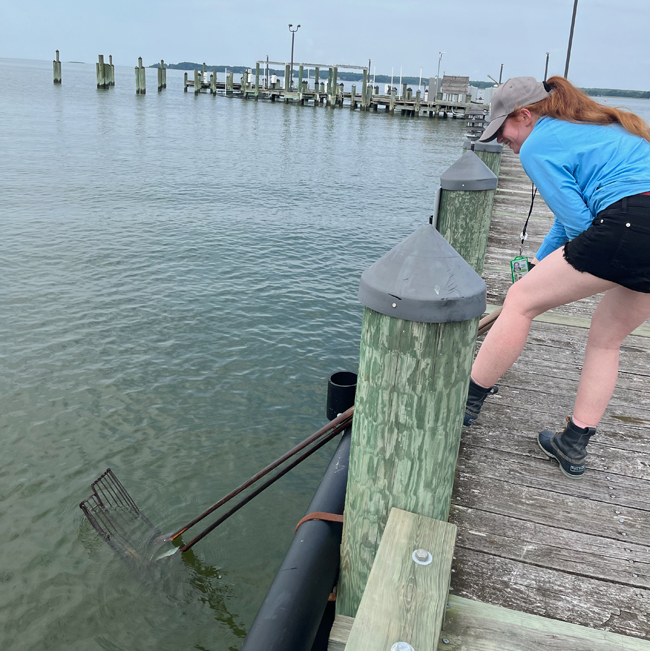
Kahn uses an oyster tong to sample oysters as part of the Chesapeake Bay Vibrio bacteria forecast, which is produced by NCCOS's Cooperative Oxford Laboratory in Oxford, Maryland. Credit: Beryl Kahn
Patricia McKee
Executive Fellow, Sea Grant's John A. Knauss Marine Policy Fellowship
U.S. Committee on the Marine Transportation System
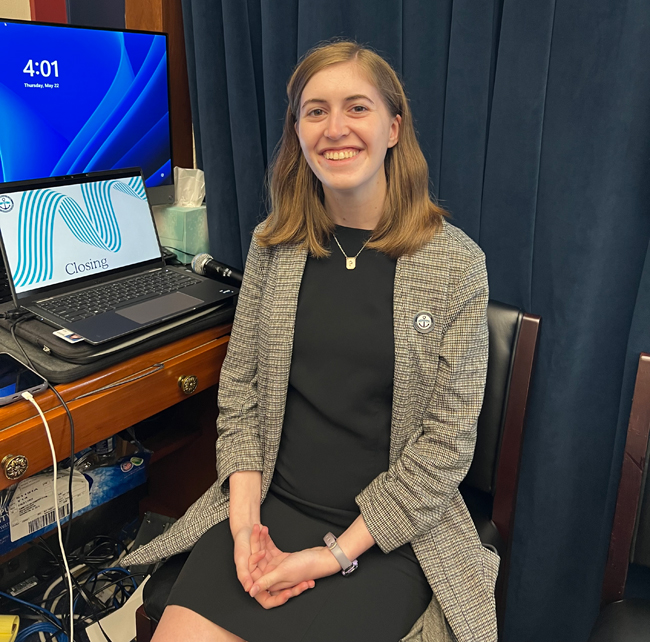
Patricia McKee poses for a picture after a Capitol Hill event. Credit: Patricia McKee
Unlike most transportation sectors, which are overseen by a single federal agency, the Marine Transportation System follows a collaborative approach. This year, I joined the U.S. Committee on the Marine Transportation System (CMTS). The CMTS is a Cabinet-level entity that facilitates federal policy coordination across more than 35 departments and agencies. In my role at the CMTS, I led three integrated action teams (IATs) — interagency groups of subject-matter experts. My portfolio included the Arctic IAT, the Maritime Innovative Science and Technology IAT, and the Offshore IAT. Beyond my work with the IATs, I also helped organize the inaugural “CMTS Day on the Hill” to promote the mariner workforce and delivered a guest lecture on the Knauss Fellowship to law students interested in oceans and coastal matters.
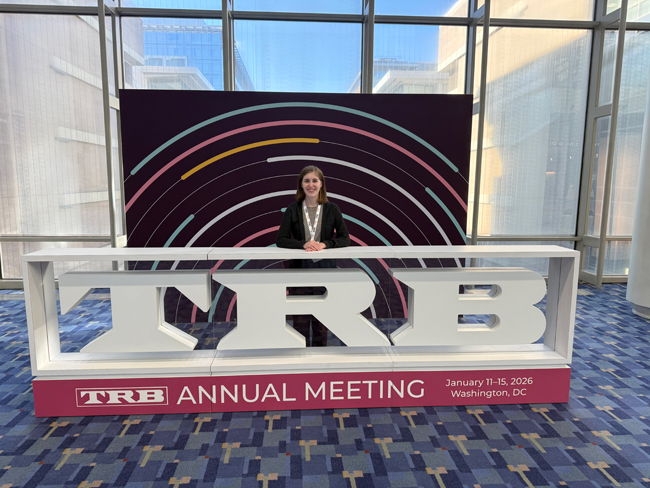
McKee attends the annual Transportation Research Board meeting in Washington, D.C. Credit: Patricia McKee
Kahad Adamu
Executive Fellow, Sea Grant's John A. Knauss Marine Policy Fellowship
NOAA OAR / National Sea Grant Office
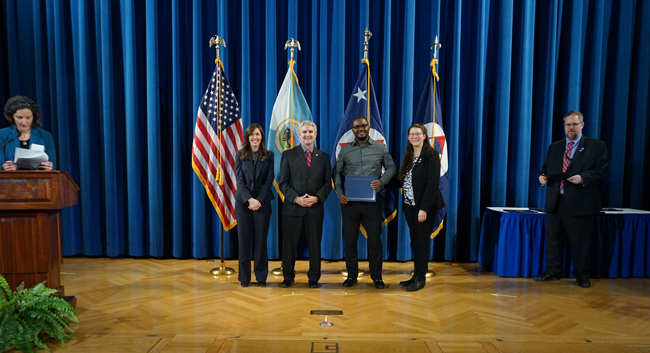
Kahad Adamu (third from right) at the 2025 Knauss Fellowship graduation. At the podium is Ms. Summer Morlock (National Sea Grant, Assistant Director for Programs) and to the far right is Dr. Joshua Brown (National Sea Grant, Performing the Duties of Deputy Director; Environmental Literacy and Workforce Development Lead). To Kahad's left is Dr. Nikola (Kola) Garber (Performing the Duties of OAR CFO/CAO; Deputy Director of National Sea Grant. To his right is Dr. Steve Thur, Assistant Administrator of NOAA's Office of Oceanic and Atmospheric Research (OAR - the line office that National Sea Grant is in). Next to Steve Thur is Ms. Laura Grimm, NOAA's Deputy Under Secretary for Oceans and Atmosphere and Acting NOAA Chief of Staff. Credit: Kahad Adamu
During the fellowship, I worked at the National Sea Grant Office (NSGO) as a Social Scientist, Economist, and Database Manager. My work included recruiting reviewers, evaluating submitted proposals for competitions such as the Climate Ready Workforce and Young Fisherman Career Development Competitions. I was also involved in evaluating projects, monitoring and reviewing data, validating information accuracy, and extracting data for official use. For me, the program was like an extension of the classroom, providing a dynamic environment for acquiring new knowledge and further developing my skills. I gained hands-on experience in several key areas, including project management, federal grant funding processes, and economic valuation. My mentors and colleagues in the office played a crucial role as tutors, sharing their depth of expertise and guiding my professional growth.
Participating in this program has greatly contributed to my professional growth. I was able to pursue and complete courses in fields such as Generative AI and Data Science/Machine Learning, which helped me develop skills that had once seemed intimidating. These courses also provided an opportunity to explore how these disciplines are relevant in areas such as urban planning, institutional development, and urban studies, which will likely improve my future job prospects.
More Info: New York Sea Grant
Established in 1966, the National Oceanic and Atmospheric Administration (NOAA)’s National Sea Grant College Program promotes the informed stewardship of coastal resources in 34 joint federal/state university-based programs in every U.S. coastal state (marine and Great Lakes) and Puerto Rico. The Sea Grant model has also inspired similar projects in the Pacific region, Korea and Indonesia.
Since 1971, New York Sea Grant (NYSG) has represented a statewide network of integrated research, education and extension services promoting coastal community economic vitality, environmental sustainability and citizen awareness and understanding about the State’s marine and Great Lakes resources.
NYSG historically leverages on average a 5.5-fold return on each invested federal dollar, annually. We benefit from this, as these resources are invested in Sea Grant staff and their work in communities right here in New York.
Through NYSG’s efforts, the combined talents of university scientists and extension specialists help develop and transfer science-based information to many coastal user groups—businesses and industries, federal, state and local government decision-makers and agency managers, educators, the media and the interested public.
New York Sea Grant, one of the largest of the state Sea Grant programs, is a cooperative program of the State University of New York (SUNY) and Cornell University. The program maintains Great Lakes offices at Cornell University, SUNY Buffalo, Rochester Institute of Technology, SUNY Oswego, the Wayne County Cooperative Extension office in Newark, and in Watertown. In the State's marine waters, NYSG has offices at Stony Brook University and with Cornell Cooperative Extension of Nassau County on Long Island, in Queens, at Brooklyn College, with Cornell Cooperative Extension in NYC, in Bronx, with Cornell Cooperative Extension of Ulster County in Kingston, and with Cornell Cooperative Extension of Westchester County in Elmsford.
For updates on Sea Grant activities: www.nyseagrant.org, follow us on social media (Facebook, Twitter/X, Instagram, Bluesky, LinkedIn, and YouTube). NYSG offers a free e-list sign up via www.nyseagrant.org/nycoastlines for its flagship publication, NY Coastlines/Currents, which it publishes 2-3 times a year.