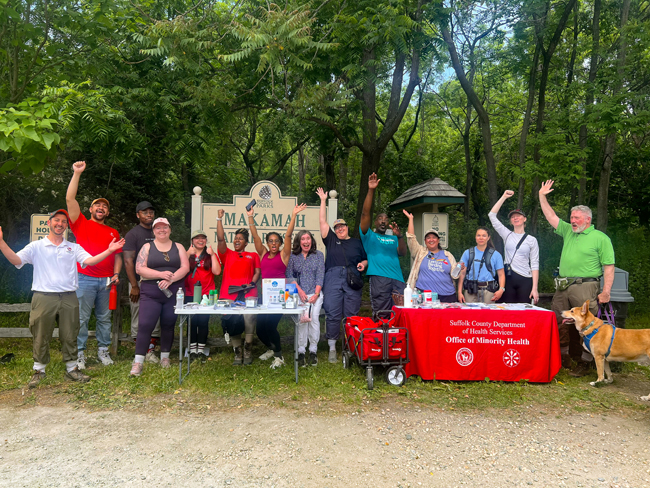
Participants cheer outside the entrance of Makamah Preserve after completing their hike. Credit: Sumayyah Uddin/NYSG
Alongside partners (including Suffolk County, Audubon, and Stony Brook Medicine), Jimena Perez-Viscasillas represented New York Sea Grant in a guided hike of Makamah Preserve in Suffolk County.
— By Sumayyah Uddin, NYSG's Science Writer
Contact:
Jimena Perez-Viscasillas, NYSG Long Island Sound Partnership Outreach Coordinator, E: jbp25@cornell.edu, P: (631) 824-4906
Stony Brook, NY, September 16, 2026 - On June 6th, participants gathered at the trailhead of Makamah Preserve for a nature walk exploring the intersection between health and natural conservation. Supported through a partnership between New York Sea Grant (NYSG), the Long Island Sound Partnership, the Health Equity and Climate Medicine Research Office at Stony Brook University, the Suffolk County Department of Health Services Office of Minority Health, and Audubon New York, the event got local community members active and out in nature while educating them about common health practices when recreating outdoors.
“We have heard over and over from local communities that accessing the coast here on Long Island isn’t always easy,” says Jimena Perez-Viscasillas, NYSG’s Outreach Coordinator for the Long Island Sound Partnership. “People have a lot on their plate nowadays, so being able to host events like this, where we combine health topics they care about while teaching about conservation and highlighting access sites near them, can hopefully make it a little easier for folks to access nature.”
The event kicked off at the trailhead, where participants had the opportunity to peruse tables for stickers and brochures before listening to a “tick talk” from Dr. Andrew Handel with Stony Brook Medicine. After thoroughly using tick spray and collecting binoculars, attendees hit the trail, led by Perez-Viscasvillas and Shelby Casas from Audubon New York, who took turns educating the group on natural features and the birds they encountered.
Here, in photos, is how the event went.
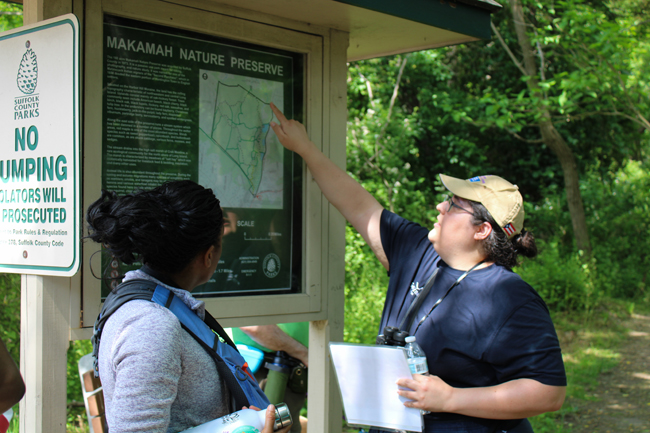
Jimena Perez-Viscasillas (right) points out the route around the preserve on the trailhead map to Dr. Danielle Craigg (Medical Program Administrator, Suffolk County Dept. of Health Services Office of Minority Health). Credit: Sumayyah Uddin/NYSG
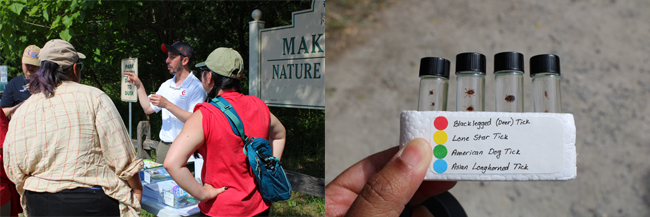
(L) Dr. Andrew Handel (a Pediatric Infectious Disease specialist at Stony Brook University Hospital) explains the risk of ticks on hikes. “One thing to keep in mind is for most infections, the longer the tick is attached, the higher the risk is,” he noted. (R) Samples of different types of ticks Long Islanders might encounter. Credit: Sumayyah Uddin/NYSG
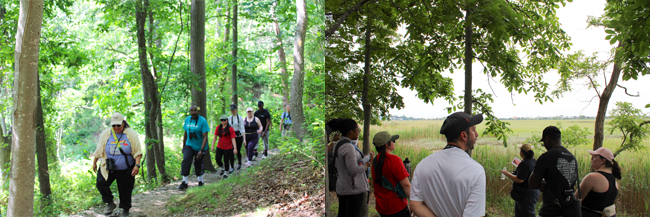
(L) Shelby Casas (Audubon New York) leads the group along the wooded trail; (R) Hikers observe the marsh as Jimena Perez-Viscasillas explains its ecological functions. Credit: Sumayyah Uddin/NYSG
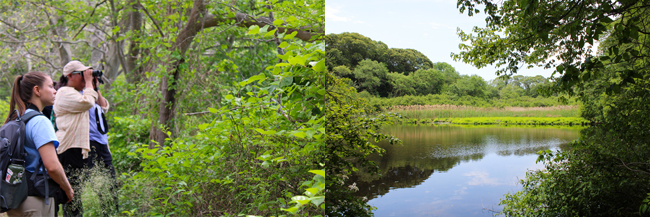
(L) Hikers pause to look for birds using binoculars given to them at the trailhead; (R) The view they were observing through their binoculars. Credit: Sumayyah Uddin/NYSG
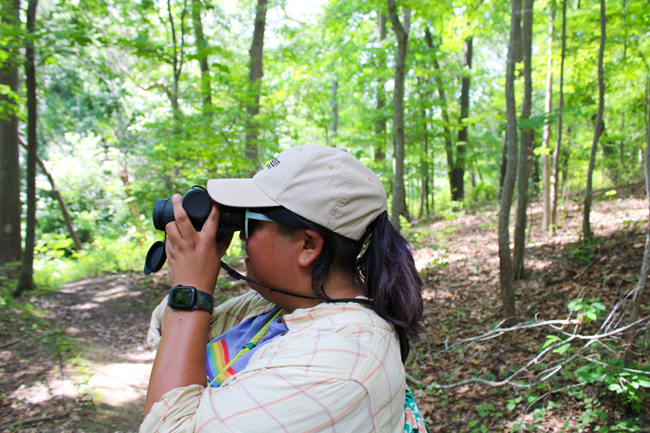
Shelby Casas (Audubon New York) observes a bird through her binoculars as she encourages hikers to do the same. Credit: Sumayyah Uddin/NYSG
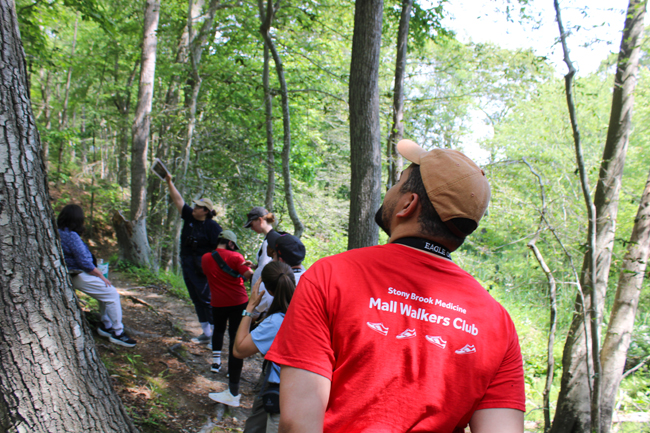
Hikers pause to listen to Jimena as she points out a natural feature of the park. Credit: Sumayyah Uddin/NYSG
More Info: New York Sea Grant
New York Sea Grant (NYSG) is a university-based, statewide Federal-State collaboration between the State University of New York (SUNY), Cornell University, and the National Oceanic and Atmospheric Administration (NOAA). It is one of 34 university-based programs that connects research, extension, and education with the needs of coastal communities, environments, and economies through NOAA.
Since 1971, NYSG has supported science-based solutions for a wide range of water-related challenges and opportunities across the state. Through NYSG’s efforts, university scientists and extension specialists help develop and transfer science and technical information to educational institutions, businesses, agencies, and industries; federal, state and local governments; the media; and the interested public. The program is administratively based at Stony Brook University (SBU) and Cornell's College of Agriculture and Life Sciences (CALS).
NYSG historically leverages on average a 5.5-fold return on each invested federal dollar, annually. The State benefits from this, as these resources are invested in Sea Grant staff and their work in communities right here in New York.
New York Sea Grant, one of the largest of the state Sea Grant programs, maintains Great Lakes offices at Cornell University, SUNY Buffalo, Rochester Institute of Technology, SUNY Oswego, the Wayne County Cooperative Extension office in Newark, and in Watertown. In the State's marine waters, NYSG has offices at Stony Brook University and with Cornell Cooperative Extension of Nassau County on Long Island, in Queens, at Brooklyn College, with Cornell Cooperative Extension in NYC, in Bronx, with Cornell Cooperative Extension of Ulster County in Kingston, and with Cornell Cooperative Extension of Westchester County in Elmsford.
Established in 1966, the National Oceanic and Atmospheric Administration (NOAA)’s National Sea Grant College Program promotes the informed stewardship of coastal resources in 34 joint federal/state university-based programs in every U.S. coastal state (marine and Great Lakes) and Puerto Rico. The Sea Grant model has also inspired similar projects in the Pacific region, Korea and Indonesia.
For updates on Sea Grant activities: www.nyseagrant.org, follow us on social media (Facebook, Twitter/X, Instagram, Bluesky, LinkedIn, and YouTube). NYSG offers a free e-list sign up via www.nyseagrant.org/nycoastlines for its flagship publication, NY Coastlines/Currents, which it publishes quarterly.