— By Sumayyah Uddin, NYSG's Science Writer
Contact:
Kathy Bunting-Howarth, NYSG's Associate Director, E: keb264@cornell.edu, P: 607-255-2832
Stony Brook, NY, November 29, 2025 - This year, New York Sea Grant (NYSG) supported two law and policy students through the New York Coastal Resilience Law and Policy Fellowship. The purpose of this fellowship is to provide students with real life policy challenges to which they can apply their legal skills while providing coastal communities with law and policy information on those challenges.
The students for 2025 were selected from City University of New York (CUNY) School of Law; and Pace University School of Law to partner with NYSG to serve local communities.
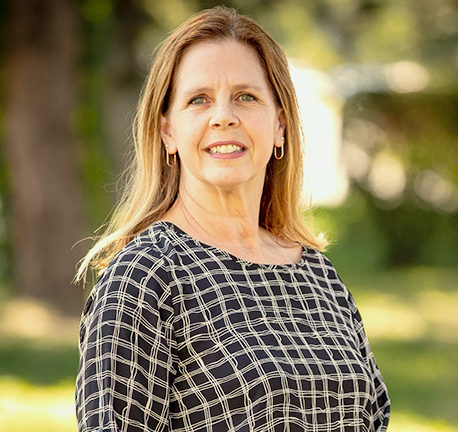
Credit: Kelly Burton
Kelly Burton was the NYSG Microfiber Policy Fellow and is a JD candidate at CUNY School of Law. Kelly has worked at the intersection of corporate sustainability and environmental innovation for two decades. As a former Chief Sustainability Officer and advisor to impact ventures, she brings deep experience navigating the challenges of turning commitments into action.
Kelly’s work this summer focused on analyzing the policy landscape for microfiber filtration laws, identifying barriers to adoption, and proposing actionable solutions.
“When you clear your lint trap, you understand that the process of washing your clothes results in this kind of excess debris or excess shedding, but that's not the only place that it happens — it’s also happening in the washing machines,” Kelly explained about her work. “There's a real opportunity for policy and legislation to require that the same trap that catches microfibers from the dryer could actually be implemented in washing machines.”
Kelly’s work this summer was published in the October 2025 edition of the SandBar, a quarterly publication produced by the National Sea Grant Law Center that reports on legal issues affecting the U.S. oceans and coasts. In “Lessons Learned: Exploring the Veto of California’s Microfiber Filtration Bill,” Kelly examines what might have led to the rejection of a California bill (AB 1628) requiring a microfiber filter in all washing machines sold in California after January 2029, and recommendations for future microfiber filtration legislation. Additional information on this topic is available via NYSG's "How Microfibers Enter the Environment" webpage.
Kelly is passionate about shaping legal frameworks that support shared value for business, people, and the planet.
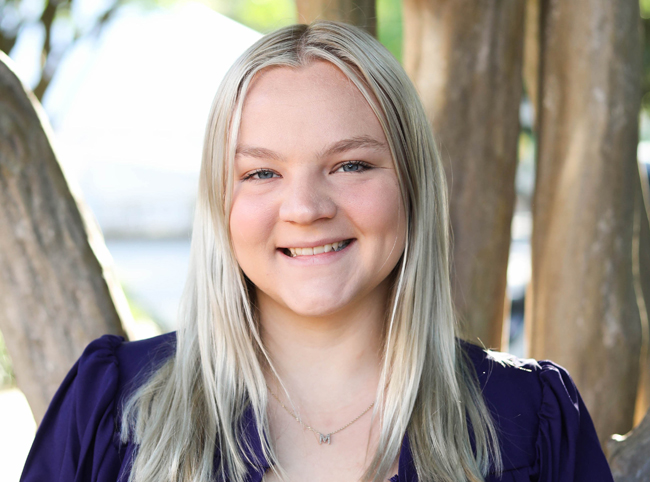
Credit: Mia Fraser
Mia Fraser is from Nashville, Tennessee, and graduated from Louisiana State University with a Bachelor of Science in Applied Coastal Environmental Science in May 2024. She is working towards her Juris Doctor with advanced certificates in environmental and international law at the Elisabeth Haub School of Law at Pace University.
Mia is passionate about coastal law and policy, its impact on coastal resiliency, and worked with NYSG this summer on assessing how communities in the Peconic Estuary could adapt their town codes to become more compatible with living shoreline projects.
“Replacing bulkheads with living shorelines where it's appropriate could help with the prioritization of living shoreline projects and quicker approval of such permits,” Mia said of her work this summer. "The benefits of living shorelines are decreasing erosion, decreasing flood and storm damage, and increasing the water quality. Some small changes in town code definitions of ‘erosion control structures,’ for example, could greatly increase the efficiency of the permitting process of these projects.”
More Info: New York Sea Grant
Established in 1966, the National Oceanic and Atmospheric Administration (NOAA)’s National Sea Grant College Program promotes the informed stewardship of coastal resources in 34 joint federal/state university-based programs in every U.S. coastal state (marine and Great Lakes) and Puerto Rico. The Sea Grant model has also inspired similar projects in the Pacific region, Korea and Indonesia.
Since 1971, New York Sea Grant (NYSG) has represented a statewide network of integrated research, education and extension services promoting coastal community economic vitality, environmental sustainability and citizen awareness and understanding about the State’s marine and Great Lakes resources.
NYSG historically leverages on average a 3 to 6-fold return on each invested federal dollar, annually. We benefit from this, as these resources are invested in Sea Grant staff and their work in communities right here in New York.
Through NYSG’s efforts, the combined talents of university scientists and extension specialists help develop and transfer science-based information to many coastal user groups—businesses and industries, federal, state and local government decision-makers and agency managers, educators, the media and the interested public.
New York Sea Grant, one of the largest of the state Sea Grant programs, is a cooperative program of the State University of New York (SUNY) and Cornell University. The program maintains Great Lakes offices at Cornell University, SUNY Buffalo, Rochester Institute of Technology, SUNY Oswego, the Wayne County Cooperative Extension office in Newark, and in Watertown. In the State's marine waters, NYSG has offices at Stony Brook University and with Cornell Cooperative Extension of Nassau County on Long Island, in Queens, at Brooklyn College, with Cornell Cooperative Extension in NYC, in Bronx, with Cornell Cooperative Extension of Ulster County in Kingston, and with Cornell Cooperative Extension of Westchester County in Elmsford.
For updates on Sea Grant activities: www.nyseagrant.org, follow us on social media (Facebook, Twitter/X, Instagram, Bluesky, LinkedIn, and YouTube). NYSG offers a free e-list sign up via www.nyseagrant.org/nycoastlines for its flagship publication, NY Coastlines/Currents, which it publishes 2-3 times a year.